
|
1 2 3 4 5 6 7 8 9 10 11 12 13 14 |
CREATE TABLE SQL_Table_005 (ID int, Function varchar(255), Derivative varchar(255)); INSERT INTO SQL_Table_005 (Function, Derivative) VALUES ('position', 'velocity') ('velocity', 'acceleration') ('momentum', 'force') ('work', 'power') ('angular momentum', 'torque') ('electric charge', 'electric current') ('magnetic flux', 'induced voltage') |
|
1 2 3 4 5 6 7 8 9 10 11 12 |
Output. +------+--------------------+--------------------+ | ID | Function | Derivative | +------+--------------------+--------------------+ | 1 | position | velocity | | 2 | velocity | acceleration | | 3 | momentum | force | | 4 | work | power | | 5 | angular momentum | torque | | 6 | electric charge | electric current | | 7 | magnetic flux | induced voltage | +------+--------------------+--------------------+ |
 is one-to-one over the given interval, then find the formulae for the inverse function
  and its derivative.



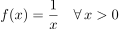
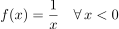
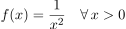

 that maps distinct elements to distinct elements; i.e.,
  , or equivalently in the contrapositive that
  . Not to be confused with one-to-one correspondence that refers to bijection.
 , its inverse
  admits an explicit description: it sends each element
  to the unique element
  such that
  .
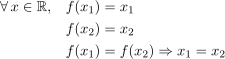
. , then
  .
.

 is injective/one-to-one.
 to exist, the original function
  must be bijective (et injective et surjective). It remains to check whether or not
  . In other words, every element of the function’s codomain is the image of at least one element of its domain.
 is a real-valued function, i.e.,
  given by
  . Obviously
  . And apparently
  . Its derivative is
  .
.