202202081217 Dynamics Figures (Elementary) Q6

13. Two identical 2\,\mathrm{kg} trolleys are connected by a light string and pulled by a 12\,\mathrm{N} force as shown. Assuming the surface to be frictionless,

(a) calculate the acceleration of the two trolleys;

(b) find the tension T in the string.

Extracted from B. Kennedy. (2001). Higher Physics Progressive Problems.


Solution.

We draw three free-body diagrams of i. m_a; ii. m_b; and iii. m_a+m_b:

In respective diagrams there are three equations of motion.

By Newton’s second law,

\textrm{Net }\mathbf{F}=m\mathbf{a}:

we have

\begin{aligned} T & = m_aa \\ 12-T & = m_ba \\ 12 & = (m_a+m_b)a \\ \end{aligned}

Answers. (a) acceleration a=3\,\mathrm{m\, s^{-2}}; (b) tension T=6\,\mathrm{N}.

202202080958 Dynamics Figures (Elementary) Q5

2. A man walking with a speed v constant in magnitude and direction passes under a lantern hanging at a height H above the ground. Find the velocity which the edge of the shadow of the man’s head moves over the ground with if his height is h.

Extracted from B. Bukhovtsev et al. (1978). Problems in Elementary Physics.


Solution.

Let x=0 be the position of the lantern; let the man walk in the positive x-direction; and let the position of the man be x_m(t) and that of the shadow of his head x_s(t). So the length s of his shadow is |x_s-x_m|.

By comparing similar triangles, we have

\displaystyle{\frac{H}{x_s} = \frac{h}{s}}.

Thus,

\begin{aligned} \frac{H}{x_s} & = \frac{h}{x_s-x_m} \\ x_s & = \bigg(\frac{H}{H-h}\bigg) x_m \\ \dot{x}_s & = \bigg(\frac{H}{H-h}\bigg) \dot{x}_m \\ \dot{x}_s & = \bigg(\frac{H}{H-h}\bigg) v \\ \end{aligned}

\therefore The edge of the shadow of the man’s head moves with a velocity (\frac{H}{H-h}) v\,\hat{\mathbf{i}} over the ground.

202202071621 Dynamics Figures (Elementary) Q4

1.3.10. A 2\,\mathrm{kg} mass and a 3\,\mathrm{kg} mass are linked by a light string passed over a frictionless pulley. Calculate the acceleration of the system.

Extracted from B. Kennedy. (2001). Higher Physics Progressive Problems.


Solution.

At first glance, as mass m_2 is heavier than mass m_1, one can expect that the heavier mass will fall down and the lighter mass will move up.

Draw the free body diagram of each mass below:

Write the equation of motion for both masses:

\begin{aligned} T-m_1g & = m_1a \\ m_2g-T & = m_2a \\ & \\ T-2g & = 2a \\ 3g-T & = 3a \\ & \\ a & = \frac{g}{5} \\ T & = \frac{12g}{5} \\ \end{aligned}

\therefore Both masses m_1 and m_2 will accelerate with a magnitude of g/5=1.96\,\mathrm{m\, s^{-2}}.

202202071437 Dynamics Figures (Elementary) Q3

1.17. A stationary object explodes into two fragments of relative mass 1:100. At the instant of break-up, the larger mass has a velocity of 10\,\mathrm{m\, s^{-1}}. Calculate i. the velocity of the smaller mass, ii. the ratio of their kinetic energies at this instant.

Extracted from M. Nelkon. (1971). Graded Exercises and Worked Examples in Physics.


Solution.

Provided that u=0, m_1:m_2=1:100, and v_2=10\,\mathrm{m\, s^{-1}}.

By the law of conservation of linear momentum,

\begin{aligned} M\mathbf{u} & = m_1\mathbf{v}_1+m_2\mathbf{v}_2 \\ (M)(0\,\hat{\mathbf{i}}) & = \bigg(\frac{1}{101}M\bigg) (-v_1\,\hat{\mathbf{i}})+\bigg(\frac{100}{101}M\bigg) (+10\,\hat{\mathbf{i}}) \\ v_1 & = 1000 \\ \mathbf{v}_1 & = -1000\,\hat{\mathbf{i}}\\ \end{aligned}

The ratio of their kinetic energies is given by

\begin{aligned} &\quad \textrm{KE}_1:\textrm{KE}_2 \\ & = \frac{\frac{1}{2}m_1v_1^2}{\frac{1}{2}m_2v_2^2} \\ & = \frac{(\frac{1}{2})(\frac{1}{101}M)(1000)^2}{(\frac{1}{2})(\frac{100}{101}M)(10)^2} \\ & = 100:1 \\ \end{aligned}

202202071039 Dynamics Figures (Elementary) Q2

The ends of a rope are fastened at separate but horizontal points on a ceiling. A 10\,\mathrm{lb} weight is hung from the rope such that the two segments of the rope make angles of 30^\circ and 45^\circ with the ceiling. Compute the tension in each segment of the rope.

Extracted from R. L. Gray. (1973). Physics Problems: Mechanics and Heat.


Solution.

Draw a free-body diagram below:

Separating the vertical and the horizontal component:

\begin{aligned} T_1\cos 45^\circ + T_2\cos 60^\circ & = W \\ T_1\sin 45^\circ & = T_2\sin 60^\circ \\ \end{aligned}

we have two equations with two unknowns (i.e., T_1 and T_2).

The rest is left the reader as an exercise.

202202070828 Dynamics Figures (Elementary) Q1

As shown in the sketch above, a mass m is suspended from a string of length L. Gravity \mathbf{g} is acting downward in the diagram. A second string exerts a horizontal force \mathbf{F} such that m is in equilibrium at a horizontal distance x.

(a) Draw a diagram showing all forces acting on m.

(b) What is the tension in the suspension string? Give both direction and magnitude.

Extracted from R. L. Gray. (1973). Physics Problems: Mechanics and Heat.


Solution.

(a) The free body diagram is shown below:

(b) Obviously,

\begin{aligned} \mathbf{T} & =F\,\hat{\mathbf{i}}+mg\,\hat{\mathbf{j}} \\ T & =|\mathbf{T}|=\sqrt{(F)^2+(mg)^2} \\ \end{aligned}.

Or, in an old-school way, we have horizontally

F=T\cos\theta

and vertically

mg=T\sin\theta,

squaring and summing up the equations,

\begin{aligned} (F)^2+(mg)^2 & =(T\cos\theta )^2+(T\sin\theta )^2 \\ F^2+m^2g^2 & = T^2(\cos^2\theta +\sin^2\theta ) \\ F^2+m^2g^2 & = T^2 \\ T & = \sqrt{F^2+m^2g^2} \\ \end{aligned}

Dividing the equation of the vertical by the horizontal,

\begin{aligned} \frac{mg}{F} & = \frac{T\sin\theta}{T\cos\theta} \\ \frac{mg}{F} & = \tan\theta \\ \theta & = \tan^{-1}\bigg(\frac{mg}{F}\bigg) \\ \end{aligned}

the direction of tension makes an angle \theta =\tan^{-1}(\frac{mg}{F}) with the level.

202204021539 Example 3, Chapter 1.3, Methods in Physics II (2015-2016 Lectures)

If \mathbf{f}(t)=t\,\hat{\mathbf{i}}+t^3\,\hat{\mathbf{j}}, \mathbf{g}(t)=\cos t\,\hat{\mathbf{i}}+\sin t\,\hat{\mathbf{j}}, and \mathbf{v}=2\,\hat{\mathbf{i}}-3\,\hat{\mathbf{j}}. Calculate

(a) (\mathbf{f}+\mathbf{g})';

(b) (\mathbf{v}\cdot\mathbf{f})';

(c) (\mathbf{f}\cdot\mathbf{g})'.


Settings. (Some properties of vector differentiation)

i. If \mathbf{f} and \mathbf{g} are differentiable vector functions,

\displaystyle{\frac{\mathrm{d}}{\mathrm{d}t}(\mathbf{f}+\mathbf{g})=\frac{\mathrm{d}\mathbf{f}}{\mathrm{d}t}+\frac{\mathrm{d}\mathbf{g}}{\mathrm{d}t}}

ii. If \mathbf{f} is a differentiable vector function and \alpha a constant scalar,

\displaystyle{\frac{\mathrm{d}}{\mathrm{d}t}(\alpha\mathbf{f})=\alpha\frac{\mathrm{d}\mathbf{f}}{\mathrm{d}t}}

iii. If \mathbf{f}(t) is a vector function, \mathbf{v} a constant vector, and \mathbf{v}\cdot\mathbf{f} differentiable,

\displaystyle{\frac{\mathrm{d}}{\mathrm{d}t}(\mathbf{v}\cdot\mathbf{f})=\mathbf{v}\cdot\frac{\mathrm{d}\mathbf{f}}{\mathrm{d}t}}

iv. If h(t) is a scalar function, \mathbf{f}(t) a vector function and h\mathbf{f} differentiable,

\displaystyle{\frac{\mathrm{d}}{\mathrm{d}t}(h\mathbf{f})=h\frac{\mathrm{d}\mathbf{f}}{\mathrm{d}t}+\mathbf{f}\frac{\mathrm{d}h}{\mathrm{d}t}}

v. If \mathbf{f} and \mathbf{g} are vector functions and \mathbf{f}\cdot\mathbf{g} differentiable,

\displaystyle{\frac{\mathrm{d}}{\mathrm{d}t}(\mathbf{f}\cdot\mathbf{g})=\mathbf{f}\cdot\frac{\mathrm{d}\mathbf{g}}{\mathrm{d}t}+\mathbf{g}\cdot\frac{\mathrm{d}\mathbf{f}}{\mathrm{d}t}}

vi. If \mathbf{f} and \mathbf{g} are vector functions and \mathbf{f}\times\mathbf{g} differentiable,

\displaystyle{\frac{\mathrm{d}}{\mathrm{d}t}}(\mathbf{f}\times\mathbf{g})=\displaystyle{\bigg( \frac{\mathrm{d}\mathbf{f}}{\mathrm{d}t}\times\mathbf{g}\bigg) + \bigg( \mathbf{f}\times \frac{\mathrm{d}\mathbf{g}}{\mathrm{d}t}\bigg)}.


Solution.

(a)

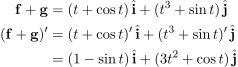
\begin{aligned} \mathbf{f}+\mathbf{g} & = (t+\cos t)\,\hat{\mathbf{i}}+(t^3+\sin t)\,\hat{\mathbf{j}} \\ (\mathbf{f}+\mathbf{g})' & = (t+\cos t)'\,\hat{\mathbf{i}}+(t^3+\sin t)'\,\hat{\mathbf{j}} \\ & = (1-\sin t)\,\hat{\mathbf{i}}+(3t^2+\cos t)\,\hat{\mathbf{j}} \\ \end{aligned}

(b)

\begin{aligned} \mathbf{v}\cdot\mathbf{f} & = (2,-3)\cdot (t,t^3) \\ & = 2t-3t^3 \\ (\mathbf{v}\cdot\mathbf{f})' & = (2t-3t^3)' \\ & = 2-9t^2 \\ \end{aligned}

(c)

\begin{aligned} \mathbf{f}\cdot\mathbf{g} & = (t,t^3) \cdot (\cos t,\sin t) \\ & = t\cos t+t^3\sin t \\ (\mathbf{f}\cdot\mathbf{g})' & = \cos t-t\sin t+t^3\cos t + 3t^2\sin t\\ \end{aligned}