202201260719 Problem 1.57

Let A=\{ x:x^2-3x+2=0\}, B=\{ x:x^2\le 16\}. Determine whether or not A\subset B.

Extracted from M. R. Spiegel. (1969). Schaum’s Outline of Theory and Problems of Real Variables


Set A and set B are described according to property method; if described by the roster method:

\begin{aligned} A & =\{ 1,2\} \\ B & = \{ -4,-3,-2,-1,0,1,2,3,4\} \\ \end{aligned}

Obviously set A is a subset of set B.


Roughwork.

(set A)

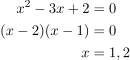
\begin{aligned} x^2-3x+2 & = 0 \\ (x-2)(x-1) & = 0 \\ x & = 1,2 \\ \end{aligned}

(set B)

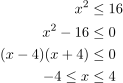
\begin{aligned} x^2 & \le 16 \\ x^2 - 16 & \le 0 \\ (x-4)(x+4) & \le 0 \\ -4\le x & \le 4 \\ \end{aligned}

202201251933 Circumference 001

Draw a circle of radius R around the center (R,0).

As the center of a circle is equidistant from all points on the circumference, using Pythagorean theorem, we have

\begin{aligned} (x-R)^2+(y-0)^2 & = R^2 \\ y^2 & = R^2 - (x-R)^2 \\ y & = \pm\sqrt{2xR-x^2} \\ |y| & = \sqrt{2xR-x^2}\\ \end{aligned}


Attempts. (reinventing the wheel)

Considering the differentials \mathrm{d}x and \mathrm{d}y, we have

\mathrm{d}y =\displaystyle{\frac{R-x}{\sqrt{2xR-x^2}}\,\mathrm{d}x}

Suppose I do not know the circumference is 2\pi R long. Let its unknown length be s, and let it be partitioned into infinitesimal \mathrm{d}s, such that

s=\displaystyle{\int\mathrm{d}s}

Assume we may write

(\mathrm{d}s)^2=(\mathrm{d}x)^2+(\mathrm{d}y)^2.

Expand the right hand side as follows

\begin{aligned} &\quad \textrm{RHS} \\ & = (\mathrm{d}x)^2+(\mathrm{d}y)^2 \\ & = (\mathrm{d}x)^2 + \bigg( \frac{R-x}{\sqrt{2xR-x^2}}\,\mathrm{d}x\bigg)^2 \\ & = \bigg(\frac{R^2}{2xR-x^2}\bigg)(\mathrm{d}x)^2 \\ \end{aligned}

Then

\begin{aligned} \mathrm{d}s & = \sqrt{\bigg( \frac{R^2}{2xR-x^2}\bigg)(\mathrm{d}x)^2} \\ s = \int\mathrm{d}s & = \int_{x=0}^{2R} \frac{R}{\sqrt{2xR-x^2}}\,\mathrm{d}x \\ \end{aligned}

Suppose I evaluate the integral above \textrm{\scriptsize{NOT}} by direct substitution \textrm{\scriptsize{BUT}} by Riemann sum, so the definite integral due to Riemann is given by

\displaystyle{\int_{a}^{b}f(x)\,\mathrm{d}x}=\lim_{n\to\infty}\sum_{i=1}^{n}f(x_{i}^{*})\, x.

For i=0,1,2,\dots ,n, let P=\{ x_i\} be a regular partition of [0,2R]. Then

x=\displaystyle{\frac{b-a}{n}=\frac{2R}{n}}.

By right-endpoint approximation for Riemann sums, for each interval [x_{i-1},x_i], we have

\displaystyle{x_i=x_0+ix=0+i\bigg[\frac{2R}{n}\bigg]=\frac{2Ri}{n}}.

Let f(x)\stackrel{\textrm{def}}{=}\displaystyle{\frac{R}{\sqrt{2xR-x^2}}}. Thus,

\begin{aligned} f(x_i) & = \frac{R}{\sqrt{(2)\displaystyle{\bigg(\frac{2Ri}{n}\bigg)}(R)-\displaystyle{\bigg(\frac{2Ri}{n}\bigg)^2}}} \\ & = \dots \\ & = \frac{n}{2\sqrt{in-i^2}} \\ \end{aligned}

Writing the Riemann sum in the form

\begin{aligned} \sum_{i=1}^{n}f(x_i)\, x & = \sum_{i=1}^{n}\frac{n}{2\sqrt{in-i^2}}\bigg(\frac{2Ri}{n}\bigg) \\ & = R\cdot \sum_{i=1}^{n}\frac{1}{\sqrt{\frac{n}{i}-1}} \\ & = R\cdot g(n) \\ \end{aligned}

Inspecting R\cdot g(n) where

g(n) = \displaystyle{ \sum_{i=1}^{n}\frac{1}{\sqrt{\frac{n}{i}-1}}}

I guess, under correction, that g(n)=2\pi.

(to be continued)


Solution. (arc-length parametrization)

Referring to the equation of locus on the very first line:

(x-R)^2+(y-0)^2=R^2,

then parameterizing x(\theta ), y(\theta ) by \theta,

\begin{aligned} x & = R+R\cos\theta \\ y & = R\sin\theta \\ \end{aligned}

and computing the derivatives wrt \theta:

\begin{aligned} \frac{\mathrm{d}x}{\mathrm{d}\theta} & = -R\sin\theta \\ \frac{\mathrm{d}y}{\mathrm{d}\theta} & = R\cos\theta \\ \end{aligned}

Note that

\displaystyle{s=\int\mathrm{d}s}

where

\mathrm{d}s=\sqrt{\displaystyle{\bigg(\frac{\mathrm{d}x}{\mathrm{d}\theta}\bigg)^2+\bigg(\frac{\mathrm{d}y}{\mathrm{d}\theta}\bigg)^2}}\,\mathrm{d}\theta.

Then,

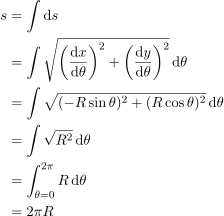
\begin{aligned} s & = \int \mathrm{d}s \\ & = \int \sqrt{\bigg( \frac{\mathrm{d}x}{\mathrm{d}\theta}\bigg)^2+\bigg( \frac{\mathrm{d}y}{\mathrm{d}\theta}\bigg)^2}\,\mathrm{d}\theta \\ & = \int \sqrt{(-R\sin\theta )^2+(R\cos\theta )^2}\,\mathrm{d}\theta \\ & = \int \sqrt{R^2}\,\mathrm{d}\theta \\ & = \int_{\theta =0}^{2\pi} R\,\mathrm{d}\theta \\ & = 2\pi R \\ \end{aligned}


(to be continued)