
Two particles move along the  -axis uniformly with speeds
  and
and  . At the initial moment the first point was
  to the left of the origin and the second
  to the right of the origin. When will the first point catch up with the second? Where will this take place? Plot the graph of the motion.
Extracted from A. A. Pinsky. (1980). Problems in Physics.
Set-up.
Rename the two particles by  and
and  . The velocity of particle is
  and that of particle is
  . The particles at time
  are located on the -axis with -coordinates
  and
and  respectively.
Roughwork.
When :

when  :
:

when  :
:

when  :
:

when  :
:

when  :
:

when  :
:

when  :
:

Solution.
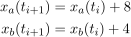
The positions  ,
,  of particle , can be expressed in a function of discrete time interval
 ,
,
i.e.,
or simply, in continuous time intervals,
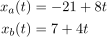
Particle will meet particle when  at some time
  , as
, as

so the place of meeting is
 .
.