Draw a circle of radius  around the center
  .
.

As the center of a circle is equidistant from all points on the circumference, using Pythagorean theorem, we have

Attempts. (reinventing the wheel)
Considering the differentials  and
and  , we have

Suppose I do not know the circumference is  long. Let its unknown length be
  , and let it be partitioned into infinitesimal
  , such that

Assume we may write
 .
.
Expand the right hand side as follows

Then

Suppose I evaluate the integral above  by direct substitution
  by Riemann sum, so the definite integral due to Riemann is given by
 .
.
For  , let
, let  be a regular partition of
 ![[0,2R]](https://physicspupil.com/wp-content/ql-cache/quicklatex.com-fb09bc7b93218a036256f8e15dab160e_l3.svg "Rendered by QuickLaTeX.com") . Then
. Then
 .
.
By right-endpoint approximation for Riemann sums, for each interval ![[x_{i-1},x_i]](https://physicspupil.com/wp-content/ql-cache/quicklatex.com-fad958508b658fc27e7653f8da54b43d_l3.svg "Rendered by QuickLaTeX.com") , we have
, we have
![\displaystyle{x_i=x_0+ix=0+i\bigg[\frac{2R}{n}\bigg]=\frac{2Ri}{n}}](https://physicspupil.com/wp-content/ql-cache/quicklatex.com-4c51443c9a4838ef917c7c064b034ba0_l3.svg "Rendered by QuickLaTeX.com") .
.
Let  . Thus,

Writing the Riemann sum in the form

Inspecting  where
where

I guess, under correction, that  .
.
(to be continued)
Solution. (arc-length parametrization)
Referring to the equation of locus on the very first line:
 ,
,
then parameterizing  ,
,  by
by  ,
,

and computing the derivatives wrt :

Note that

where
 .
.
Then,
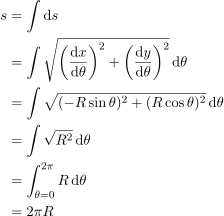
(to be continued)

 ,
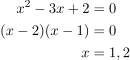
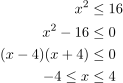
,  . Determine whether or not
  .
. and set
  are described according to property method; if described by the roster method:
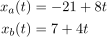
 -axis uniformly with speeds
  and
and  . At the initial moment the first point was
  to the left of the origin and the second
  to the right of the origin. When will the first point catch up with the second? Where will this take place? Plot the graph of the motion.
 and
and  . The velocity of particle
  and that of particle
  . The particles at time
  are located on the
  and
and  respectively.
 :
:
 :
:
 :
:
 :
:
 :
:
 :
:
 :
:
 ,
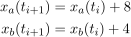
,  of particle
  ,
,
 at some time
  , as
, as
 .
. ,
,  , and
, and  . Then,


 ‘s are gained .