202112031054 Kinematics graphs (Elementary) Q1

The graph below illustrates three paths in Red (R), Green (G), and Blue (B).

For a person walking along paths R, G, and B at a constant speed 2\,\mathrm{m\, s^{-1}}, find, in each path,

(a) the distance travelled;
(b) the time needed from start to finish; and
(c) the displacement and velocity on the journey.


Solution.

(a)

Along path R, the walking distance d is

\begin{aligned} \textrm{Distance }d & = \bigg(\frac{1}{2}\bigg) \big(\pi (90-50)\big) + \bigg(\frac{1}{2}\bigg) \big( \pi (50-30)\big) \\ & = \bigg(\frac{1}{2}\bigg) (40\pi ) + \bigg(\frac{1}{2}\bigg) (20\pi ) \\ & = 20\pi + 10\pi \\ & = 30\pi\,\mathrm{m} \\ \end{aligned}

Along path G, the walking distance d is

\begin{aligned} \textrm{Distance }d & = \sqrt{(30-0)^2+(60-20)^2} + \sqrt{(30-0)^2+(100-60)^2} \\ & = \sqrt{900+1600} + \sqrt{900+1600} \\ & = \sqrt{2500} + \sqrt{2500} \\ & = 50+50 \\ & = 100\,\mathrm{m} \end{aligned}

Along path B, the walking distance d is

\begin{aligned} \textrm{Distance }d & = (20-0) + (20-0) + (50-20) + (50-20) \\ & \qquad\quad + (100-50) + (100-50) \\ & = 20+20+30+30+50+50 \\ & = 200\,\mathrm{m} \\ \end{aligned}

(b)

Along path R, the time t needed is

\begin{aligned} \textrm{Time }t & = \frac{30\pi\,\mathrm{m}}{2\,\mathrm{m\, s^{-1}}} \\ & = 47.1\,\mathrm{s}\\ \end{aligned}

Along path G, the time t needed is

\begin{aligned} \textrm{Time }t & = \frac{100\,\mathrm{m}}{2\,\mathrm{m\, s^{-1}}} \\ & = 50\,\mathrm{s}\\ \end{aligned}

Along path B, the time t needed is

\begin{aligned} \textrm{Time }t & = \frac{200\,\mathrm{m}}{2\,\mathrm{m\, s^{-1}}} \\ & = 100\,\mathrm{s}\\ \end{aligned}

(c)

Read the following graph, and you shall see each and every displacement in dashed lines.

For path R, the displacement \mathbf{s} travelled is

\begin{aligned} \textrm{Displacement }\mathbf{s} & = - s\,\hat{\mathbf{i}} \\ & = - (90-30)\,\hat{\mathbf{i}} \\ & = - 60\,\mathrm{m}\,\hat{\mathbf{i}} \\ \end{aligned}

and the velocity \mathbf{v} is

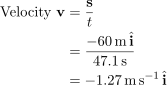
\begin{aligned} \textrm{Velocity }\mathbf{v} & = \frac{\mathbf{s}}{t} \\ & = \frac{- 60\,\mathrm{m}\,\hat{\mathbf{i}}}{47.1\,\mathrm{s}} \\ & = -1.27\,\mathrm{m\, s^{-1}}\,\hat{\mathbf{i}} \\ \end{aligned}

For path G, the displacement \mathbf{s} travelled is

\begin{aligned} \textrm{Displacement }\mathbf{s} & = s\,\hat{\mathbf{j}} \\ & = (100-20)\,\hat{\mathbf{j}} \\ & = 80\,\mathrm{m}\,\hat{\mathbf{j}} \\ \end{aligned}

and the velocity \mathbf{v} is

\begin{aligned} \textrm{Velocity }\mathbf{v} & = \frac{\mathbf{s}}{t} \\ & = \frac{80\,\mathrm{m}\,\hat{\mathbf{j}}}{50\,\mathrm{s}} \\ & = +1.6\,\mathrm{m\, s^{-1}}\,\hat{\mathbf{j}} \\ \end{aligned}

For path B, the displacement \mathbf{s} travelled is

\begin{aligned} \textrm{Displacement }\mathbf{s} & = 100\,\mathrm{m}\,\hat{\mathbf{i}} + 100\,\mathrm{m}\,\hat{\mathbf{j}} \\ \end{aligned}

or, the magnitude s of displacement \mathbf{s} is

\begin{aligned} s & = \sqrt{(100)^2+(100)^2} \\ & = 100\sqrt{2}\,\mathrm{m} \\ \end{aligned}

such that

\mathbf{s} = s\cos 45^\circ\,\hat{\mathbf{i}} + s\sin 45^\circ\,\hat{\mathbf{j}}

the velocity \mathbf{v} is

\begin{aligned} \textrm{Velocity }\mathbf{v} & = \frac{\mathbf{s}}{t} \\ & = \frac{100\,\mathrm{m}\,\hat{\mathbf{i}} + 100\,\mathrm{m}\,\hat{\mathbf{j}}}{100\,\mathrm{s}} \\ & = +1\,\mathrm{m\, s^{-1}}\,\hat{\mathbf{i}} + 1\,\mathrm{m\, s^{-1}}\,\hat{\mathbf{j}}\\ \end{aligned}