202112021444 Solution to 1979-CE-AMATH-I-1

Let \displaystyle{y=x+\frac{1}{x^2}}. Find \displaystyle{\frac{\mathrm{d}y}{\mathrm{d}x}} from first principles.


Solution.

From first principles,
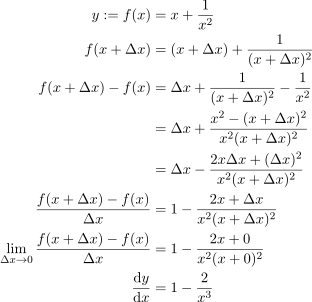
\begin{aligned} y:=f(x) & =x+\frac{1}{x^2} \\ f(x+\Delta x) & =(x+\Delta x) + \frac{1}{(x+\Delta x)^2} \\ f(x+\Delta x)-f(x) & = \Delta x + \frac{1}{(x+\Delta x)^2} - \frac{1}{x^2} \\ & = \Delta x + \frac{x^2-(x+\Delta x)^2}{x^2(x+\Delta x)^2} \\ & = \Delta x - \frac{2x\Delta x+(\Delta x)^2}{x^2(x+\Delta x)^2} \\ \frac{f(x+\Delta x)-f(x)}{\Delta x} & = 1 - \frac{2x + \Delta x}{x^2(x+\Delta x)^2} \\ \lim_{\Delta x\to 0}\frac{f(x+\Delta x)-f(x)}{\Delta x} & = 1 - \frac{2x + 0}{x^2(x+0)^2} \\ \frac{\mathrm{d}y}{\mathrm{d}x} & = 1 - \frac{2}{x^3} \\ \end{aligned}


Playground.

To make fun of calculus, do let
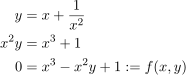
\begin{aligned} y & =x+\frac{1}{x^2} \\ x^2y & =x^3+1 \\ 0 & = x^3-x^2y+1 := f(x,y) \\ \end{aligned}

where f(x,y) is a degree 3 polynomial in two variables x and y.

The set of solutions to f(x,y)=0 is

\begin{cases} \enspace x \neq 0 \\ \enspace  y = \frac{x^3+1}{x^2} \end{cases}

Computing \partial_xf and \partial_yf as follow:

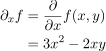
\begin{aligned} \partial_xf & = \frac{\partial}{\partial x}f(x,y) \\ & = 3x^2-2xy \\ \end{aligned}

and

\begin{aligned} \partial_yf & = \frac{\partial}{\partial y}f(x,y) \\ & = -x^2 \\ \end{aligned},

we oversee the relation

\mathrm{d}f = (\partial_xf)(\Delta x)+(\partial_yf)(\Delta y).


Definition. (Singularity and Smoothness)

A point p=(a,b) on a curve \mathcal{C}=\{ (x,y)\in\mathbb{C}^2:f(x,y)=0\} is said to be singular if

\begin{aligned} \frac{\partial f}{\partial x}(a,b) & = 0 \\ \frac{\partial f}{\partial y}(a,b) & = 0 \\ \end{aligned}.

A point that is not singular is called smooth. If there is at least one singular point on \mathcal{C}, then curve \mathcal{C} is called a singular curve. If there are no singular points on \mathcal{C}, the curve \mathcal{C} is called a smooth curve.

C.f. Definition 1.9.1, T. Carrity, et al., Algebraic Geometry: A Problem Solving Approach


That said, in our scenario

f(x,y)=x^3-x^2y+1,

the set of candidates for singularity

\{ (a,b)\in\mathbb{C}^2\enspace \mathrm{s.t.}\enspace f(a,b)=0\textrm{ and }\partial_xf(a,b)=\partial_yf(a,b)=0\}.

is empty.

\therefore The curve \mathcal{C}=\{ (x,y)\in\mathbb{C}^2:x^3-x^2y+1=0\} is smooth, thus everywhere differentiable.


Wait, the function in question should be the curve

F(x)=\displaystyle{x+\frac{1}{x^2}};

still, for better or worse, F(x) is \textrm{\scriptsize{NOT}} a differentiable function because the derivative does \textrm{\scriptsize{NOT}} exist at x=0, for that point is a discontinuity.

202112021138 SQL Table 004

Background. (Equilibrium)

Equilibrium is established by the exchange of energy, volume, or particle number between different systems or subsystems.

Section 2.2. Arovas. (2019). Thermodynamics and Statistical Mechanics


202112021037 Exercise 1.4 Lagrangian actions

For a free particle an appropriate Lagrangian is

Eq. (1.8):

\mathcal{L}(t,x,v)=\displaystyle{\frac{1}{2}mv^2}.

Suppose that x is the constant-velocity straight-line path of a free particle, such that x_a=x(t_a) and x_b=x(t_b). Show that the action on the solution path is

Eq. (1.9):

\displaystyle{\frac{m}{2}\frac{(x_b-x_a)^2}{t_b-t_a}}.

Extracted from Structure and Interpretation of Classical Mechanics, SICP, 2e


Background. (Lagrangians and Lagrangian actions)

The function \mathcal{L} is called a Lagrangian for the system, and the resulting action,

Eq. (1.4):

S[q](t_1,t_2)=\displaystyle{\int_{t_1}^{t_2}\mathcal{L}\circ\Gamma [q]},

is called the Lagrangian action. For Lagrangians that depend only on time, positions, and velocities the action can also be written

Eq. (1.5):

S[q](t_1,t_2)=\displaystyle{\int_{t_1}^{t_2}\mathcal{L}(t,q(t),\mathrm{D}q(t))\,\mathrm{d}t}.

(Section 1.3 The Principle of Stationary Action)


Working. (roughly)

\begin{aligned} S & = \int_{t_a}^{t_b}\frac{1}{2}mv^2\,\mathrm{d}t \\ & = \frac{m}{2}\int_{t_a}^{t_b}(\mathbf{v}\cdot\mathbf{v})\,\mathrm{d}t \\ & = \frac{m}{2}\int_{t_a}^{t_b}\bigg( \frac{\mathrm{d}\mathbf{x}}{\mathrm{d}t}\cdot\frac{\mathrm{d}\mathbf{x}}{\mathrm{d}t}\bigg) \,\mathrm{d}t \\ & = \frac{m}{2}\int_{x_a,t_a}^{x_b,t_b}\frac{(\mathrm{d}x)^2}{(\mathrm{d}t)} \\ & = \frac{m}{2}\frac{(x_b-x_a)^2}{t_b-t_a} \\ \end{aligned}