
This post is depreciated as it is misleading the reader about the speed of train.
The number  should be the “mission order” of the train which indicates to stationed staff of its running railway, service time, and need of assistance if any (MTR Academy, 2017).
An MTR train enters the station at a speed of  kilometres an hour, i.e.,
  .
.

Retrieved image from http://mtr.hk365day.com/
If the subway is  long and the train terminates at the stop with constant deceleration, i.e.,
  ,
,

Modified figures retrieved from https://www.shutterstock.com/
what is the time required for the train to come to a full stop?
Background. (Equations of linear motion in uniform acceleration)

Solution.
Take the rightward to be positive direction.
Provided that the initial velocity  is
is

the final velocity  is
is
 , or simply put,
  ;
;
and the displacement  for the duration is
 ,
,
so, out of five variables:
 ,
,  ,
,  ,
,  , and
, and  ,
,
we already know three exactly:
(of magnitude );
(of magnitude );
(of magnitude ).
If the first step were to solve for only one unknown in the equations of motion i – iv below,
i.  is
is  solvable for there are two unknowns and ;
ii.  solvable for there is
  one unknown ;
iii.  solvable for there are two unknowns and ;
iv.  solvable for there is one unknown .
thus, we should pick equation ii. to calculate the unknown .
That said, solving for time ,

Afterword.
 If you wish to know about the rate of deceleration
  , you can use equation iv., yet this is left the reader.
 The time might seem longer than expected, because normally the deceleration of train is non-constant.
 normally shines on a metal surface. The metal is made up of a simple cubic lattice of atoms with lattice spacing
  . Each atom has one free electron. The binding energy at the metal surface is
  . Suppose further that the light is uniformly distributed over the surface and all its energy is absorbed by the surface electrons.
 ), Green (
 ), and Blue (
 ).
).
 , find, in each path,
 is
is


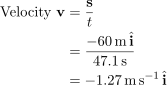




 . Find
  from first principles.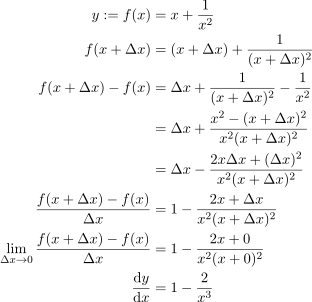
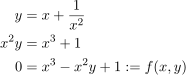
 is a degree
  polynomial in two variables
  and
and  .
. is
is
 and
and  as follow: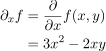
 ,
, .
. on a curve
  is said to be singular if
 .
. , then curve
  ,
, .
. The curve
  is smooth, thus everywhere differentiable.
 ;
; is
is  , for that point is a discontinuity.
 .
. and
and  . Show that the action on the solution path is
 .
. is called a Lagrangian for the system, and the resulting action,
=\displaystyle{\int_{t_1}^{t_2}\mathcal{L}\circ\Gamma [q]}](https://physicspupil.com/wp-content/ql-cache/quicklatex.com-9d7d2672f3816268f5da303bbe467e82_l3.svg "Rendered by QuickLaTeX.com") ,
,=\displaystyle{\int_{t_1}^{t_2}\mathcal{L}(t,q(t),\mathrm{D}q(t))\,\mathrm{d}t}](https://physicspupil.com/wp-content/ql-cache/quicklatex.com-7d8271909556980bfae03db83466e3f5_l3.svg "Rendered by QuickLaTeX.com") .
.