202102190222 Homework 1 (Q2)

Show whether or not the function (a) f(z)=\mathrm{Re}(z)=x; (b) f(z)=z^2 is analytic.


Setup.

Theorem 1. Suppose f:\Omega \rightarrow \mathbb{C} is analytic. Then, writing

f(z)=f(x+\mathrm{i}y)=u(x,y)+\mathrm{i}v(x,y)

with u(x,y)=\mathrm{Re}(f(z)) and v(x,y)=\mathrm{Im}(f(z)), we have the Cauchy-Riemann equations

\begin{cases} \displaystyle{\frac{\partial u}{\partial x}} & = \displaystyle{\frac{\partial v}{\partial y}} \\ \displaystyle{\frac{\partial u}{\partial y}} & = \displaystyle{-\frac{\partial v}{\partial x}} \end{cases}

everywhere on \Omega.

Theorem 2. If f:\Omega\rightarrow \mathbb{C} is of class \mathcal{C}^1, f=u+\mathrm{i}v. Then (u,v) satisfies the Cauchy-Riemann equations if and only if f is analytic.


(a) Now that

u(x,y)=x and v(x,y)=0,

the partial derivatives are as follows
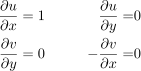
\begin{aligned} \frac{\partial u}{\partial x}  & = 1 & \qquad \frac{\partial u}{\partial y}  = & 0 \\ \frac{\partial v}{\partial y} & = 0 & \qquad -\frac{\partial v}{\partial x}  = & 0 \\ \end{aligned}

Since

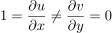
1=\displaystyle{\frac{\partial u}{\partial x}}\neq \displaystyle{\frac{\partial v}{\partial y}}=0,

the Cauchy-Riemann equations are not satisfied, and f is \textrm{\scriptsize{NOT}} analytic.

(b)

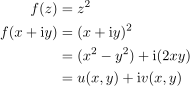
\begin{aligned} f(z) & = z^2 \\ f(x+\mathrm{i}y) & = (x+\mathrm{i}y)^2 \\ & = (x^2-y^2)+\mathrm{i}(2xy) \\ & = u(x,y)+\mathrm{i}v(x,y) \end{aligned}

where u(x,y)=x^2-y^2 and v(x,y)=2xy.

Then,

\displaystyle{\frac{\partial u}{\partial x}} = 2x, \displaystyle{\frac{\partial u}{\partial y}} = -2y, \displaystyle{\frac{\partial v}{\partial y}} = 2x, \displaystyle{-\frac{\partial v}{\partial x}} = -2y

and the Cauchy-Riemann equations are satisfied. f is thus analytic.

Leave a Reply

Your email address will not be published. Required fields are marked *