202102190301 Homework 1 (Q3)

Find the analytic functions w(z)=u(x,y)+\mathrm{i}v(x,y) if

(a) u(x,y)=x^3-3xy^2;

(b) v(x,y)=e^{-y}\sin x.


Attempts.

(a)

\displaystyle{\frac{\partial u}{\partial x}}=3x^2-3y^2.

From (first of the Cauchy-Riemann equations)

\displaystyle{\frac{\partial u}{\partial x}}=\displaystyle{\frac{\partial v}{\partial y}},

we have

v=\displaystyle{\int} (3x^2-3y^2)\,\mathrm{d}y+g(x)

where g is a function independent of y. Then

v=3x^2y-y^3+g(x).

Now

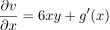
\displaystyle{\frac{\partial v}{\partial x}}=6xy+g'(x);

\displaystyle{\frac{\partial u}{\partial y}}=-6xy

From (second of the Cauchy-Riemann equations)

\displaystyle{\frac{\partial u}{\partial y}}=-\displaystyle{\frac{\partial v}{\partial x}},

we have

-6xy=-6xy-g'(x)

i.e.,

g'(x)=0;

g(x)=C.

Thus v(x,y)=3x^2y-y^3+C for some constant C\in\mathbb{R}.


Part (b) is left to the reader.

202102190222 Homework 1 (Q2)

Show whether or not the function (a) f(z)=\mathrm{Re}(z)=x; (b) f(z)=z^2 is analytic.


Setup.

Theorem 1. Suppose f:\Omega \rightarrow \mathbb{C} is analytic. Then, writing

f(z)=f(x+\mathrm{i}y)=u(x,y)+\mathrm{i}v(x,y)

with u(x,y)=\mathrm{Re}(f(z)) and v(x,y)=\mathrm{Im}(f(z)), we have the Cauchy-Riemann equations

\begin{cases} \displaystyle{\frac{\partial u}{\partial x}} & = \displaystyle{\frac{\partial v}{\partial y}} \\ \displaystyle{\frac{\partial u}{\partial y}} & = \displaystyle{-\frac{\partial v}{\partial x}} \end{cases}

everywhere on \Omega.

Theorem 2. If f:\Omega\rightarrow \mathbb{C} is of class \mathcal{C}^1, f=u+\mathrm{i}v. Then (u,v) satisfies the Cauchy-Riemann equations if and only if f is analytic.


(a) Now that

u(x,y)=x and v(x,y)=0,

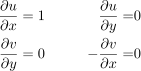
the partial derivatives are as follows

\begin{aligned} \frac{\partial u}{\partial x}  & = 1 & \qquad \frac{\partial u}{\partial y}  = & 0 \\ \frac{\partial v}{\partial y} & = 0 & \qquad -\frac{\partial v}{\partial x}  = & 0 \\ \end{aligned}

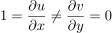
Since

1=\displaystyle{\frac{\partial u}{\partial x}}\neq \displaystyle{\frac{\partial v}{\partial y}}=0,

the Cauchy-Riemann equations are not satisfied, and f is \textrm{\scriptsize{NOT}} analytic.

(b)

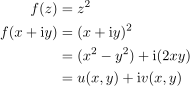
\begin{aligned} f(z) & = z^2 \\ f(x+\mathrm{i}y) & = (x+\mathrm{i}y)^2 \\ & = (x^2-y^2)+\mathrm{i}(2xy) \\ & = u(x,y)+\mathrm{i}v(x,y) \end{aligned}

where u(x,y)=x^2-y^2 and v(x,y)=2xy.

Then,

\displaystyle{\frac{\partial u}{\partial x}} = 2x, \displaystyle{\frac{\partial u}{\partial y}} = -2y, \displaystyle{\frac{\partial v}{\partial y}} = 2x, \displaystyle{-\frac{\partial v}{\partial x}} = -2y

and the Cauchy-Riemann equations are satisfied. f is thus analytic.

202102190159 Homework 1 (Q1)

(a) Find the reciprocal of x+\mathrm{i}y, working entirely in the Cartesian representation.

(b) Repeat part (a), working in polar form but expressing the final result in Cartesian form.


Solution.

(a)

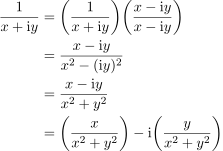
\begin{aligned} \frac{1}{x+\mathrm{i}y} & = \bigg( \frac{1}{x+\mathrm{i}y}\bigg) \bigg( \frac{x-\mathrm{i}y}{x-\mathrm{i}y}  \bigg) \\ & = \frac{x-\mathrm{i}y}{x^2-(\mathrm{i}y)^2} \\ & = \frac{x-\mathrm{i}y}{x^2+y^2} \\ & = \bigg( \frac{x}{x^2+y^2}  \bigg) - \mathrm{i}\bigg( \frac{y}{x^2+y^2} \bigg) \end{aligned}

(b)

Let

x+\mathrm{i}y\stackrel{\mathrm{def}}{=}z=re^{\mathrm{i}\varphi}

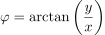
where r=\sqrt{x^2+y^2} and \varphi = \arctan\bigg( \displaystyle{\frac{y}{x}} \bigg).

Then, the reciprocal of z=x+\mathrm{i}y is

\begin{aligned} \frac{1}{z} & = \frac{1}{re^{\mathrm{i}\varphi}} \\ & = \frac{1}{r}\, e^{\mathrm{i}(-\varphi )} \\ & = \frac{1}{r}\, \mathrm{cis}(-\varphi )\\ & = \frac{1}{r}\big(\cos (-\varphi)+\mathrm{i}\sin (-\varphi )\big)\\ & = \frac{1}{r}(\cos\varphi -\mathrm{i}\sin\varphi ) \\ & = \frac{1}{\sqrt{x^2+y^2}}\bigg[ \frac{x}{\sqrt{x^2+y^2}} - \mathrm{i}\Big( \frac{y}{\sqrt{x^2+y^2}}  \Big) \bigg] \\ & = \bigg( \frac{x}{x^2+y^2}  \bigg) - \mathrm{i}\bigg( \frac{y}{x^2+y^2} \bigg) \end{aligned}