202101141227 Exercise 1 (Q10)

If f(x)=2x^2, find expressions for:

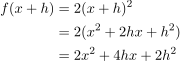
1. f(x+h).

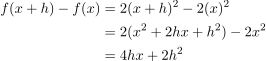
2. f(x+h)-f(x).

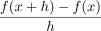
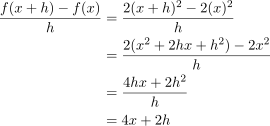
3. \displaystyle{\frac{f(x+h)-f(x)}{h}}.


Solution.

1.

\begin{aligned} f(x+h) & = 2(x+h)^2 \\ & = 2(x^2+2hx+h^2) \\ & = 2x^2+4hx+2h^2 \end{aligned}

2.

\begin{aligned} f(x+h)-f(x) & = 2(x+h)^2 - 2(x)^2 \\ & = 2(x^2+2hx+h^2) - 2x^2 \\ & = 4hx+2h^2 \\ \end{aligned}

3.

\begin{aligned} \frac{f(x+h)-f(x)}{h} & = \frac{2(x+h)^2-2(x)^2}{h} \\ & = \frac{2(x^2+2hx+h^2)-2x^2}{h} \\ & = \frac{4hx+2h^2}{h} \\ & = 4x+2h \\ \end{aligned}


Remark.

The first step to derivation from first principles, is calculate the slope of tangent

\displaystyle{\frac{f(x+h)-f(x)}{h}},

and put the limit h\to 0, i.e.,

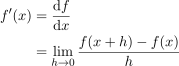
\begin{aligned} f'(x) & =\displaystyle{\frac{\mathrm{d}f}{\mathrm{d}x}} \\ & = \displaystyle{\lim_{h\to 0}\frac{f(x+h)-f(x)}{h}} \end{aligned}

a right-hand limit.


Afterword.

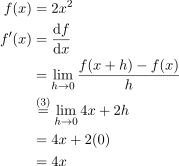
\begin{aligned} f(x) & =2x^2 \\ f'(x) & = \frac{\mathrm{d}f}{\mathrm{d}x} \\ & = \lim_{h\to 0}\frac{f(x+h)-f(x)}{h} \\ & \stackrel{\textrm{(3)}}{=} \lim_{h\to 0} 4x+2h \\ & = 4x+2(0) \\ & = 4x \end{aligned}

Leave a Reply

Your email address will not be published. Required fields are marked *