Let  .
.
(a) Describe all the elements in  and the maps
  for
for  . Is
. Is  surjective? (Use the notation
  to denote the map sending from
  to
to  and from to .)
(b) Repeat part (a) for the group  .
.
Setup.
 is the set of all bijective maps from
  to itself. And the group
  is the group where
  is the composition of maps.

is the group embedding of  into
into  , where

is the left translation of .
(a)
Thus, the elements of  are altogether the following bijections:
![\begin{aligned} & \\ [0] & \mapsto [0] \\ [1] & \mapsto [1] \end{aligned}](https://physicspupil.com/wp-content/ql-cache/quicklatex.com-b50b1e5a1bb77cfd2775c1ff0f4d2412_l3.svg "Rendered by QuickLaTeX.com")
and
![\begin{aligned} & \\ [0] & \mapsto [1] \\ [1] & \mapsto [0] \end{aligned}](https://physicspupil.com/wp-content/ql-cache/quicklatex.com-53b254300bac960438e700342f99e691_l3.svg "Rendered by QuickLaTeX.com") ,
,
or equivalently, in matrices,
 and
and
The left translation  is
is

But ![[0]+[0]=[0]\quad (\mathrm{mod}\,2)](https://physicspupil.com/wp-content/ql-cache/quicklatex.com-2057c82fcf182c6454d58ed5d076919c_l3.svg "Rendered by QuickLaTeX.com") and
and ![[0]+[1]=[1]\quad (\mathrm{mod}\,2)](https://physicspupil.com/wp-content/ql-cache/quicklatex.com-d80aa925cbd485ba0a331a3ae5570520_l3.svg "Rendered by QuickLaTeX.com") ,
,
hence in matrix is .
The left translation  is
is

But ![[1]+[0]=[1]\quad (\mathrm{mod}\,2)](https://physicspupil.com/wp-content/ql-cache/quicklatex.com-f4cff6bdd3028598d82bf0e34c93a0a8_l3.svg "Rendered by QuickLaTeX.com") and
and ![[1]+[1]=[0]\quad (\mathrm{mod}\,2)](https://physicspupil.com/wp-content/ql-cache/quicklatex.com-68765ec0b17cc8fd57c275d7c9ea441c_l3.svg "Rendered by QuickLaTeX.com") ,
,
hence in matrix is .
It is hence checked that the range of the left translations , is inside (or, more precisely, equal to) the codomain
Then, I can say  , the mappings of which are explicitly the following two:
 and
and  ;
;
by the definition ![l(a): a\mapsto l_a\qquad \forall\, a\in\{ [0],[1]\}=\mathbb{Z}_2](https://physicspupil.com/wp-content/ql-cache/quicklatex.com-c9a2d55f34d4a86462c0b4d51c0d81ba_l3.svg "Rendered by QuickLaTeX.com") .
.
Recall that a function is said to be surjective if the range of function constitutes its whole codomain. Thus, is surjective.
(b)
Let ![G=\mathbb{Z}_3(=\{ [0],[1],[2] \})](https://physicspupil.com/wp-content/ql-cache/quicklatex.com-307dd37bf2e00c030341eb3791342c0f_l3.svg "Rendered by QuickLaTeX.com") .
.
All the one-to-one mappings are listed as follows:
 .
.
First, the left translation is

Since ![[0]+[0]=[0]\quad (\mathrm{mod}\,3)](https://physicspupil.com/wp-content/ql-cache/quicklatex.com-20029d40f298b8ef6a01f807724eace0_l3.svg "Rendered by QuickLaTeX.com") ,
, ![[0]+[1]=[1]\quad (\mathrm{mod}\,3)](https://physicspupil.com/wp-content/ql-cache/quicklatex.com-15b30d55655276b606599bedfbb634d4_l3.svg "Rendered by QuickLaTeX.com") , and
, and ![[0]+[2]=[2]\quad (\mathrm{mod}\,3)](https://physicspupil.com/wp-content/ql-cache/quicklatex.com-b6c60586f80f4eb589dc5b7d4c163d34_l3.svg "Rendered by QuickLaTeX.com") , I may write
, I may write
 .
.
Secondly, the left translation is

Since ![[1]+[0]=[1]\quad (\mathrm{mod}\,3)](https://physicspupil.com/wp-content/ql-cache/quicklatex.com-82561d79c35e3e112953ac65d9e3a81e_l3.svg "Rendered by QuickLaTeX.com") ,
, ![[1]+[1]=[2]\quad (\mathrm{mod}\,3)](https://physicspupil.com/wp-content/ql-cache/quicklatex.com-b3d3cd5aba19197c2dea23c6451d648e_l3.svg "Rendered by QuickLaTeX.com") , and
, and ![[1]+[2]=[0]\quad (\mathrm{mod}\,3)](https://physicspupil.com/wp-content/ql-cache/quicklatex.com-f8f3d03a4893721a97768f4019470331_l3.svg "Rendered by QuickLaTeX.com") , I may write
, I may write
 .
.
Thirdly and lastly, the left translation  is
is

Since ![[2]+[0]=[2]\quad (\mathrm{mod}\,3)](https://physicspupil.com/wp-content/ql-cache/quicklatex.com-216755ac897610110bc9d821f5e366e0_l3.svg "Rendered by QuickLaTeX.com") ,
, ![[2]+[1]=[0]\quad (\mathrm{mod}\,3)](https://physicspupil.com/wp-content/ql-cache/quicklatex.com-b211878f7f2f30baec90ce7416454d54_l3.svg "Rendered by QuickLaTeX.com") , and
, and ![[2]+[2]=[1]\quad (\mathrm{mod}\,3)](https://physicspupil.com/wp-content/ql-cache/quicklatex.com-293dfc89ba0dd997d2fd648eb6104422_l3.svg "Rendered by QuickLaTeX.com") , I may write
, I may write
 .
.
To sum up what is up till now, 
Then, I can say  , the mappings of which are explicitly the following three:
 ,
,  , and
, and  .
.
by the definition ![l(a): a\mapsto l_a\qquad \forall\, a\in\{ [0],[1],[2]\}=\mathbb{Z}_2](https://physicspupil.com/wp-content/ql-cache/quicklatex.com-8a8a21b3702ab3f296ad71f484b54030_l3.svg "Rendered by QuickLaTeX.com") .
.
in the case of  is
is  surjective because in the codomain , the following three elements
 ,
,  , and
, and 
are not inside the range of .
 is said to be a group embedding if it is an injective group homomorphism.
 , we define the left translation of
 ,
,  .
. .
.

 , or
, or  , or,
, or,  for
for  , then
  guaranteed that the inverse of
  always exists in
  .
. in which
  is the identity of
  .
. , show that
  .
. where
where  is an integer.
 if
if  and
and  where
where  .
. , show that for any
  , there exists a subgroup of order
  in
in  or
or  for some
  and
and  . Then one may write
  . It can be seen that
  must be
  where
where  contradicts to the assumption that
  where
where  . Thus
  , and
, and  .
. . Secondly, if
  such that
  , from the result of part
  because if
  and
and  , then
  (here
(here  ),
),  , and
, and  . Such a
  will always be greater than or equal to
  . Thus
  .
. .
. where
where  is given in the problem. The order of the cyclic subgroup
  of
of  , in view of the result in part
  where
where  is a subgroup of
  , then
  . Note that
  . Consider the subgroup
  . Because
  divides
  and thus
  . From the result of part
  . Thus
  and
and  whenever
  .
. and
and  is inside
  . Thus
  is inside
  in
in  (by the condition
  whenever
  , one proves the existence of the inverse. Thirdly,
  because
  and also
  .
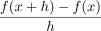
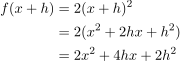
.  , find expressions for:
 .
. .
. .
.

 , i.e.,