Find the trajectory of a cannon ball fired by a cannoneer at  above his eye level with an initial speed
  .
.
Ans.
Imagine you are in his place, like the picture below:

Then, suppose you are opening fire at such positive  -axis direction as that follows along the meridian. In addition, assume that the earth is to be lying flat beneath the cannon ball during its flight, that every pole (
 -axis) upheld would be so much right-angled (/normal /perpendicular) to the ground as parallel (-transported) anywhere.
We neglect air friction.
1. Along the  -direction, the speed is kept
  .
.
2. Along the -direction, the speed is initially  . By the laws of gravity, the cannon ball will experience a net force
  due to gravitational pull by the Earth. If upward direction is taken the positive sign, an equation of motion due to the Galilean transformation (i.e.,
  ) will depict that
  .
.
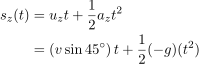
3. One another equation  depicts how distance
  (i.e., the magnitude of displacement
  ) varies with time
  during linear motion in constant acceleration
  .
.
One might have already noticed I am setting the original question aside, as it were. Let’s pinpoint the answer now.
The trajectory should be obtained in the form:
 .
.
where
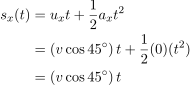
and