
i. Prove that  is irrational; and
ii. Determine whether  is rational or not.
Solution.
i. Assume on the contrary that be rational, may I rewrite it in terms of a quotient (or a fraction) where the numerator and the nonzero denominator are a pair of coprime integers.
I.e.,  where
where  and
and  .
.
Roughwork.

From  we have
  .
.
So let  for some integer
  .
.
Roughwork.
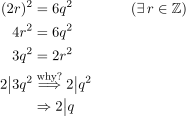
We have also seen  .
.
If and when both statements and meet, it implies  and
and  are no more coprime, and thus a contradiction.
Definition. (Coprime) Two integers  and
and  are said to be coprime if the only positive integer that divides them both is one. Equivalently speaking, the greatest common divisor (gcd) of and is 1,i.e.,
  , or written simply,
  . Synonymous with
 coprime' are relatively prime’, `mutually prime’, and the like.
ii.
To prove or disprove from scratch, assume that be rational, and see what happens. Let

for some coprimes  s.t. .

Contradiction arises  .
.
 is irrational.
(to be continued)
(doing another way around)
To make use of part i., one might find the Lemma below useful:
Lemma. The product of any two rational numbers is again one rational number.
Proof. Let  and
and 
be rational numbers in their simplest forms reducible.

If were rational, again were its square rational in view of the aforementioned Lemma. Just make an experiment in so doing:

On logic,

However, as shown in part i., is irrational. The assumption that be rational has been contradicted.
The contrary is true that is  rational.