202008190019 Exercise 1.28

In each case, determine all real x and y which satisfy the given relation.

(a) x+\mathrm{i}y=|x-\mathrm{i}y|,

(b) x+\mathrm{i}y=(x-\mathrm{i}y)^2,

(c) \displaystyle{\sum_{k=0}^{100}}\mathrm{i}^k=x+\mathrm{i}y.


Solution.

(a)

\begin{aligned} x + \mathrm{i}y & = |x-\mathrm{i}y|  \\ x + \mathrm{i}y &  = \sqrt{(x)^2+(-y)^2} \\ x + \mathrm{i}y & = \big(  \sqrt{(x)^2+(-y)^2}  \big) + \mathrm{i}(0) \end{aligned}

\therefore y=0 and x\enspace (\geqslant 0)\, \in\mathbb{R} is any non-negative real number.

(b)

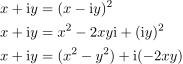
\begin{aligned} x + \mathrm{i}y & = (x-\mathrm{i}y)^2 \\ x + \mathrm{i}y & = x^2 - 2xy\mathrm{i} + (\mathrm{i}y)^2 \\ x + \mathrm{i}y & = (x^2-y^2) + \mathrm{i}(-2xy) \end{aligned}

Comparing the imaginary parts:

\begin{aligned} y=-2xy & \Rightarrow (2x+1)y = 0 \\ & \Rightarrow x = -\frac{1}{2}\qquad \textrm{or}\qquad y=0 \end{aligned}

Comparing the real parts:

\begin{aligned} x & = x^2-y^2 \\ x^2 - x - y^2 & = 0 \\ x & = \frac{-(-1)\pm \sqrt{(-1)^2-4(1)(-y^2)}}{2(1)} \\ & = \frac{1\pm \sqrt{1+4y^2}}{2} \end{aligned}

When y=0, x=\displaystyle{\frac{1\pm \sqrt{1+4(0)^2}}{2}}=0,\, 1.

When x=-\frac{1}{2},

\begin{aligned} -\frac{1}{2} & =\frac{1\pm\sqrt{1+4y^2}}{2} \\ \Rightarrow 2 & = \sqrt{1+4y^2} \\ \Rightarrow y & = \pm \displaystyle{\frac{\sqrt{3}}{2}} \end{aligned}

\therefore \begin{pmatrix} x \\ y \end{pmatrix}\in \Bigg\{ \begin{pmatrix} 0 \\ 0 \end{pmatrix},\,\begin{pmatrix} 1 \\ 0 \end{pmatrix},\, \begin{pmatrix} -\frac{1}{2} \\ \frac{\sqrt{3}}{2} \end{pmatrix},\, \begin{pmatrix} -\frac{1}{2} \\ -\frac{\sqrt{3}}{2} \end{pmatrix}   \Bigg\}.

(c)

\begin{aligned} \sum_{k=0}^{k=100}\mathrm{i}^k & = x+\mathrm{i}y \\ \mathrm{i}^{0} + \mathrm{i}^{1} + \mathrm{i}^{2} + \dots + \mathrm{i}^{100} & = x+\mathrm{i}y \\ \sum_{n=0}^{50} \mathrm{i}^{(2n)} + \sum_{n=0}^{49} \mathrm{i}^{(2n+1)} & = x+\mathrm{i}y \\ \sum_{n=0}^{50} (-1)^n + \mathrm{i}\sum_{n=0}^{49} (-1)^{n} & = x+\mathrm{i}y \\ \end{aligned}

\begin{aligned} \therefore \qquad x & = \sum_{n=0}^{50}(-1)^n \\ & = (-1)^{0} + (-1)^{1} + (-1)^{2} +\dots + (-1)^{50} \\ & = 1-1+1+\dots +1 \\ & = 1 \end{aligned}

\begin{aligned} \therefore \qquad y & = \sum_{n=0}^{49}(-1)^n \\ & = (-1)^{0} + (-1)^{1} + (-1)^{2} +\dots + (-1)^{49} \\ & = 1-1+1+\dots -1 \\ & = 0 \end{aligned}

Sol. \bigg\{\begin{aligned} & x = 1 \\ & y = 0 \end{aligned}\bigg\}.

Leave a Reply

Your email address will not be published. Required fields are marked *