
Consider a probability density of the Gaussian distribution

where  ,
,  , and
, and  are constants.
You probably wish to know 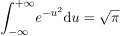 .
.
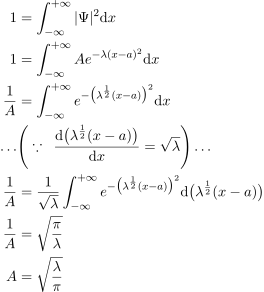
- Determine according to the normalizing rules.
- Find
 ,
,  , and
, and  , the standard deviation of
  .
. - Sketch the graph of
 .
.
Solution:
Roughwork.
-
Recall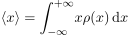 , Eq. (1.17) in Griffith's
 Introduction to Quantum MechanicsFirst,
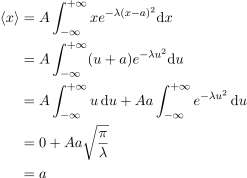
The section below sets a bad example of computation, the second equality sign being wishful thinking, and what follows thence is incorrect.

Recall the formula for integration by parts is , or,
, or,  .
.
Evaluate term-by-term, the first term is
![\begin{aligned} &\quad A\int_{-\infty}^{+\infty} x^2e^{-\lambda x^2}\,\mathrm{d}x\\ & = \frac{A}{2} \int_{-\infty}^{+\infty} xe^{-\lambda x^2}\,\mathrm{d}(x^2) \\ & =\frac{A}{2} \Bigg\{ \bigg[ \frac{-xe^{-\lambda x^2}}{\lambda}\bigg]_{-\infty}^{+\infty} -\int_{-\infty}^{+\infty} \frac{-e^{-\lambda x^2}}{\lambda}\,\mathrm{d}(x^2) \Bigg\} \\ \dots & \Bigg( \quad \mathrm{d}(\sqrt{\lambda}x^2) = \frac{1}{2\sqrt{\lambda}}\,\mathrm{d}(x^2) \quad \Bigg) \dots \\ & =\frac{A}{2} \Bigg\{ \bigg[ \frac{-xe^{-\lambda x^2}}{\lambda}\bigg]_{-\infty}^{+\infty} +\frac{2\sqrt{\lambda}}{\lambda}\int_{-\infty}^{+\infty}e^{-(\sqrt{\lambda} x)^2} \mathrm{d}(\sqrt{\lambda}x^2) \Bigg\} \\ & = \frac{A}{2} \bigg( 0+2\sqrt{\frac{\pi}{\lambda}}\bigg) \\ & = \frac{\sqrt{\frac{\lambda}{\pi}}}{2} \bigg( 2\sqrt{\frac{\pi}{\lambda}}\bigg) \\ & = 1 \end{aligned}](https://physicspupil.com/wp-content/ql-cache/quicklatex.com-ccc51bfed93d4a598541a424631c0b45_l3.svg "Rendered by QuickLaTeX.com")
The terrible blunder ends here.
Correction.
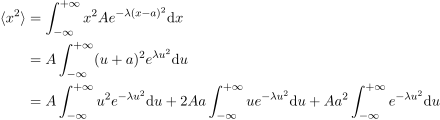
Step back to look closer, the third term is the easiest to compute:
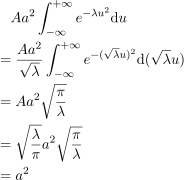
The first two terms might need to be evaluated using integration by parts. On the other hand, from the angle of parity, in the second term
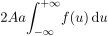
where 

is an odd function. The definite integral upon evaluation will be nought:
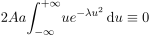 .
.
The first term can be checked

where 
that  is an even function.
Upon evaluation the definite integral will have the property that
 ,
,
though it seems not useful here. Doing integration by parts,
![\begin{aligned} & \quad A \displaystyle{\int_{-\infty}^{+\infty}}u^2e^{-\lambda u^2}\mathrm{d}u \\ & = \frac{A}{\sqrt{\lambda}} \int_{-\infty}^{+\infty} u^2e^{-(\sqrt{\lambda}u)^2}\mathrm{d}(\sqrt{\lambda}u) \\ & = \frac{A}{\sqrt{\lambda}} \Bigg\{ \bigg[ \frac{u^2e^{-(\sqrt{\lambda}u)^2}}{-2(\sqrt{\lambda}u)} \bigg]\bigg|_{-\infty}^{+\infty} -\int_{-\infty}^{+\infty} \frac{e^{-(\sqrt{\lambda}u)^2}}{-2(\sqrt{\lambda}u)} \Big( \frac{2u}{\sqrt{\lambda}} \Big) \mathrm{d}(\sqrt{\lambda}u) \Bigg\} \\ & = \frac{A}{\sqrt{\lambda}} \Bigg\{ 0+ \frac{1}{\lambda}\int_{-\infty}^{+\infty} e^{-(\sqrt{\lambda}u)^2} \mathrm{d}(\sqrt{\lambda}u) \Bigg\} \\ & = A\frac{1}{\sqrt{\lambda}}\frac{1}{\lambda}\sqrt{\pi} \\ & = \sqrt{\frac{\lambda}{\pi}} \frac{1}{\sqrt{\lambda}}\frac{1}{\lambda}\sqrt{\pi} \\ & = \frac{1}{\lambda} \end{aligned}](https://physicspupil.com/wp-content/ql-cache/quicklatex.com-3c04fbbc74deb75a6ae9dfaa94a05213_l3.svg "Rendered by QuickLaTeX.com")
Thus 
As  ,
,
 .
.