When projected in the air and subjected only to gravity, a projectile performs projectile motion. Its path/trajectory is a parabola. If the projectile is projected at an angle of projection, it is said to be in general projectile motion; else, it is said to be in horizontal projectile motion.
The duration of time from projection to landing is called the time of flight. The maximum height the projectile can reach is usually measured from the launch level. The range of projection is the horizontal distance the projectile has travelled from projection to landing.
Horizontally Projected Motion
When air resistance is negligible, a projectile moves at a uniform horizontal velocity and at a uniform vertical acceleration due to gravity. As its motion in the horizontal and in the vertical are independent of each other, so we separate the projectile motion into two perpendicular directions—the horizontal and the vertical—in order to resolve and analyse it.
i.  ; ii.
; ii.  ; iii.
  ; iv.
; iv.  are what you need.

At any instant  :
:
horizontal motion ( ,
,  ):
):
 ;
;
 OR
OR 
vertical motion ( ,
,  ):
):
 ;
;
 ;
;
 ;
;
the velocity  can be found by

its trajectory is parabolic:  .
.
General Projectile Motion
A projectile is now projected with an initial velocity  at an angle
  . As usual, we separate the motion into horizontal and vertical directions. At any instant , the magnitude of its velocity is
  , and its direction makes an angle
  with the level, where
  .
.

Horizontal motion: The initial horizontal velocity is  . After some time , its horizontal displacement is
  OR
OR  and its velocity remains to be
  OR
OR  .
.
(Neglecting air friction, we assume zero horizontal acceleration, i.e., .)
Vertical motion: The initial vertical velocity is  . After some time , its vertical displacement is
  OR
OR  and its velocity changes to
  OR
OR  .
.
(Upward taken to be +ve, the vertical acceleration due to gravity is )
Better to know the equations of motion well in deriving, than to simply memorize the formulae in solving, the unknowns, lest it be wrong in some cases, say, on a slant.
Time of flight : Consider only the vertical motion, by ①: 
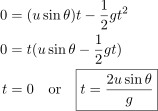
Or, by ②: , and that the object lands with the same speed as is launched, we have  , which also gives
  .
.
Range  : Consider only the horizontal motion, by
  (
( )
)


 is maximum if
  (
( ).
). 
 .
.  Both angles and
  give the same range.
Maximum height  : Consider only the vertical motion, by ①:


Or, by ②: and that it takes half of the time of flight to reach , we have  and thus the same result.
CONCEPT TEST
- As shown in the figure, three objects
 ,
,  , and
, and  are projected horizontally and travelled along their respective trajectories. Objects and are projected at the same height.
  Neglecting air resistance, which of the following statements are true?
- The time of flight of is longer than that of .
- The time of flight of is equal to that of .
- The horizontal velocity of is less than that of .
- The initial velocity of is greater than that of .
- (I) and (II)
- (I) and (IV)
- (II) and (III)
- (II) and (IV)
- As shown in the figure, two objects
 and
and  are in general projectile motion. They reach the same maximum height.
  Neglecting air resistance, which of the following statements are wrong?
- The acceleration of is greater than that of .
- The time of flight of is equal to that of .
- The velocity of is equal to that of when they are at the maximum height.
- The velocity of is greater than that of at the time of landing.
- (I) and (II)
- (I) and (III)
- (II) and (III)
- (III) and (IV)
- An object is now in general projectile motion. Which of the following graphs are correct?


- (I) and (II)
- (I) and (III)
- (II) and (IV)
- (III) and (IV)
Answers:
- D
- B
- B
Explanations:
- Since
 , time of flight is given by
  . From
  , we get
  . Thus (I) is wrong and (II) correct. The horizontal velocity is given by
  . From
  , we get
  . Thus (III) is wrong and (IV) correct.
- The acceleration of and of is due to gravity, and is equal to
 (Upward taken to be +ve). Thus (I) is wrong. Let the vertical component of initial velocity be
  . From
  , we know that and have the same magnitude in their vertical component of initial velocity. Thus they have the same time of flight and (II) is correct. From
  , where
  , we know that the horizontal velocity of is greater than that of . The velocity at maximum height is
  . Thus
  and (III) is wrong. Again by resolving components, the velocity at the time of landing is
  . From
  being equal and
  of greater than that of , it follows that (IV) is correct.
- By the conservation of mechanical energy,
 , i.e.,
  . Arranging it into the form
  , we have
  . Thus (I) is correct. (II) is wrong because during the flight, there must be a non-zero horizontal component of velocity and thus
  . The maximum height
  . We can readily fit it into the form
  , where
  ,
,  , and
, and  . Hence (III) is correct. From , it follows that
  . We can likewise fit it into a parabola
  where ,
  ,
,  ,
,  , and
, and  . The graph (IV) is far from correct.

 of an object of mass
  and speed
  .
. , it can be expected that after some time of flight
  , the object will return to its initial position, its downward speed in which is equal to the initial upward speed
  of time
![v:[0,T]\subset \mathbb{R} \rightarrow [0,u]\subset \mathbb{R}](https://physicspupil.com/wp-content/ql-cache/quicklatex.com-0f0e7e6d2e33bb3ad0132facb2eff3e1_l3.svg "Rendered by QuickLaTeX.com") given by
given by  .
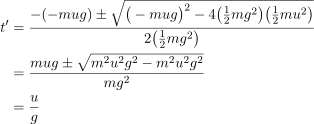
.![\begin{aligned} v^2 & =(u-gt)^2\quad \big( =(-u+gt)^2\big) \\ & = u^2-2ugt+g^2t^2 \quad \big(\forall\, t\in [0,T] \big) \end{aligned}](https://physicspupil.com/wp-content/ql-cache/quicklatex.com-4d73fad5be84dfa1676a03a2ae22042d_l3.svg "Rendered by QuickLaTeX.com") .
. is
is
 are constants.
 :
:
 for
for  :
: ,
, of an object can be given by a function
  .
. of the object from time
  to
to  is a function of time
  .
. ),
),![\begin{aligned} s(4) & = \int_0^4 (0.5t+2) \,\mathrm{d}t \\ & = \big[0.25t^2+2t\big] \big|_0^4 \\ & = 0.25(4)^2+2(4) \\ & = 12 \end{aligned}](https://physicspupil.com/wp-content/ql-cache/quicklatex.com-13d71db5db1e732d32354158d5e89082_l3.svg "Rendered by QuickLaTeX.com")