
Two mass points,  and
and  , move under the influence of a mutual central force, where the central force potential is given by
  . Assume the center of mass is at the rest, please find the equivalent one-body problem and show that the corresponding Lagrangian can be written as

where  is the relative distance between the two mass points and
  is the reduced mass.
Solution.
(Reference: https://www.physics.rutgers.edu/~shapiro/507/book4(DOT)pdf)
Let  and
and  . Expressing
  and
and  in terms of
  and
and  , we write
 ,
,

where  .
.
The kinetic energy  is computed as follows:
![\begin{aligned} T & = \displaystyle{\frac{1}{2}m_1\dot{r}_1^2}+\displaystyle{\frac{1}{2}m_2\dot{r}_2^2} \\ & = \displaystyle{\frac{1}{2}m_1\Bigg[ \displaystyle{\frac{\mathrm{d} }{\mathrm{d}t}} \bigg( \mathbf{R}-\displaystyle{\frac{m_2}{M}}\mathbf{r} \bigg)\Bigg]^2}+\displaystyle{\frac{1}{2}m_2\Bigg[ \displaystyle{\frac{\mathrm{d} }{\mathrm{d}t}} \bigg( \mathbf{R}+\displaystyle{\frac{m_1}{M}}\mathbf{r}\bigg)\Bigg]^2} \\ & = \displaystyle{\frac{1}{2}}(m_1+m_2)\dot{R}^2+\displaystyle{\frac{1}{2}\frac{m_1m_2}{M}}\dot{r}^2 \\ & = \displaystyle{\frac{1}{2}}M\dot{R}^2+\displaystyle{\frac{1}{2}\mu\dot{r}^2} \\ \end{aligned}](https://physicspupil.com/wp-content/ql-cache/quicklatex.com-bae3f6e13d15acac4b16c326b584a55b_l3.svg "Rendered by QuickLaTeX.com")
where  is the reduced mass
  .
.
From its formula above, can be seen as the sum of the kinetic energy of the motion of the centre of mass, i.e.,  , and the kinetic energy of motion about the centre of mass, i.e.,
  .
.
And from the fact that the Lagrangian  is cyclic on
  , the centre of mass is either at rest or in uniform motion.
Thus the equation of motion for  will not contain terms involving or
  . We may hence ignore the first term, and what remains in the Lagrangian is
 .
.
Now that we introduce a spherical coordinate system given by its equation of transformation from the Cartesian as:

we can write the kinetic energy as
![\begin{aligned} T & =\displaystyle{\frac{1}{2}}\mu (\dot{x}^2+\dot{y}^2+\dot{z}^2) \\ & = \displaystyle{\frac{1}{2}}\mu[(\dot{r}\sin\theta\cos\phi+\dot{\theta}r\cos\theta\cos\phi -\dot{\phi}r\sin\theta\sin\phi)^2\\ & \qquad +(\dot{r}\sin\theta\sin\phi+\dot{\theta}r\cos\theta\sin\phi+\dot{\phi}r\sin\theta\cos\phi)^2\\ & \qquad +(\dot{r}\cos\theta -\dot{\theta}r\sin\theta)^2]\\ & = \displaystyle{\frac{1}{2}}\mu [\dot{r}^2+r^2\dot{\theta}^2+r^2\sin^2\theta\dot{\phi}^2]\\ \end{aligned}](https://physicspupil.com/wp-content/ql-cache/quicklatex.com-195dc9c02ba8f625976bafde7af46e40_l3.svg "Rendered by QuickLaTeX.com")
(Note that the kinetic energy is cyclic on the coordinate  and the conjugate momentum
  . Observe that
  is the distance between the particle and the
  -axis, and it can be easily seen that
  is the -component of the angular momentum
  .)
.)
To simplify things, we choose the direction of angular momentum as the -direction. It follows that  ,
,  , and
, and  .
.
I wish to obtain the Euler-Lagrange equation for . Hence I compute the following:

Then one can express the one-body problem as:
 ,
,
or,
 ,
,
or,
 ,
,
where 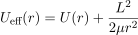 is the effective potential.
 are present. Integrate the equation to obtain the velocity as a function of time and show that maximum possible velocity for a fall from rest is
  .
. by noting
 and
and  ,
, .
.

 as variable, I may obtain a first-order differential equation:
