201902250313 Solution to 1987-AL-PHY-I-30

The electrostatic force \mathbf{F}_{XW} acting on the charge -Q at X due to another charge +Q at W is given by Coulomb’s Law:

\mathbf{F}_{XW}=\displaystyle{\frac{(-Q)(+Q)}{4\pi\epsilon_0r^2}}\,\hat{\mathbf{i}}=-\displaystyle{\frac{Q^2}{4\pi\epsilon_0r^2}}\,\hat{\mathbf{i}},

whereas the electrostatic force \mathbf{F}_{XY} due to another charge -Q at Y is given similarly by:

\mathbf{F}_{XY}=\displaystyle{\frac{(-Q)(-Q)}{4\pi\epsilon_0r^2}}\,\hat{\mathbf{j}}=\displaystyle{\frac{Q^2}{4\pi\epsilon_0r^2}}\,\hat{\mathbf{j}}.

When a fourth charge q is placed on Z, which is at a distance of \sqrt{2}r from X where r is the side length of the square, the magnitude of electrostatic force F_{XZ} is given by:

F_{XZ}=\displaystyle{\frac{(-Q)(q)}{4\pi\epsilon_{0}(\sqrt{2}r)^2}}=\displaystyle{\frac{-Qq}{8\pi\epsilon_0r^2}}.

The electrostatic force \mathbf{F}_{XZ} is then given by:

\begin{aligned} \mathbf{F}_{XZ} & = F_{XZ}(\cos 45^\circ )\,\hat{\mathbf{i}} +F_{XZ}(\sin 45^\circ )\,\hat{\mathbf{j}} \\ & = \bigg( \frac{-Qq}{8\pi\epsilon_0r^2} \bigg) \frac{\sqrt{2}}{2} \,\hat{\mathbf{i}} + \bigg( \frac{-Qq}{8\pi\epsilon_0r^2} \bigg) \frac{\sqrt{2}}{2} \,\hat{\mathbf{j}} \\ & = \frac{-\sqrt{2}Qq}{16\pi\epsilon_0r^2} \,\hat{\mathbf{i}} + \frac{-\sqrt{2}Qq}{16\pi\epsilon_0r^2} \,\hat{\mathbf{j}} \end{aligned}


When the net electrostatic force acting on position X is in the left direction only, by summing over the above-calculated three forces, i.e.,

\begin{aligned} \sum \mathbf{F} & =\mathbf{F}_{XW}+\mathbf{F}_{XY}+\mathbf{F}_{XZ} \\ & = \bigg( -\displaystyle{\frac{Q^2}{4\pi\epsilon_0r^2}}+\frac{-\sqrt{2}Qq}{16\pi\epsilon_0r^2}\bigg) \,\hat{\mathbf{i}} + \bigg(\displaystyle{\frac{Q^2}{4\pi\epsilon_0r^2}} + \frac{-\sqrt{2}Qq}{16\pi\epsilon_0r^2}\bigg) \,\hat{\mathbf{j}} \end{aligned}

the vertical component of the electrostatic force must be zero, i.e.,
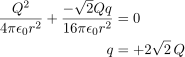
\begin{aligned} \displaystyle{\frac{Q^2}{4\pi\epsilon_0r^2}} + \frac{-\sqrt{2}Qq}{16\pi\epsilon_0r^2} & =0 \\ q & = +2\sqrt{2}\,Q \end{aligned}

And the answer is E.