201902200847 Exercise 11 Chapter 2

When two billiard balls collide, the instantaneous forces between them are very large but act only in an infinitesimal time \Delta t, in such a manner that the quantity

\displaystyle{\int_{\Delta t}}F\,\mathrm{d}t

remains finite. Such forces are described as impulsive forces, and the integral over \Delta t is known as the impulse of the force. Show that if impulsive forces are present Lagrange’s equations may be transformed into

\bigg( \displaystyle{\frac{\partial \mathcal{L}}{\partial \dot{q}_j}} \bigg)_f-\bigg( \displaystyle{\frac{\partial \mathcal{L}}{\partial \dot{q}_j}} \bigg)_i=S_j,

where the subscripts i and f refer to the state of the system before and after the impulse, S_j is the impulse of the generalized impulsive force corresponding to q_j, and \mathcal{L} is the Lagrangian including all the non-impulsive forces.


Solution.

This solution is not mine. It was found on the Internet some years ago, to whose author(s) I lost references.

For billiard-balls collision, the Euler-Lagrange (E-L) equation is

\displaystyle{\frac{\mathrm{d}}{\mathrm{d}t}}\bigg( \frac{\partial L}{\partial \dot{q_j}}\bigg)-\bigg( \frac{\partial L}{\partial q_j}\bigg)=Q_j,

where Q_j is the generalised impulsive force corresponding to q_j and not derivable from the potential.

Taking integral over \Delta t on both sides,

LHS becomes

\displaystyle{\int_{\Delta t}\frac{\displaystyle{\mathrm{d}\bigg( \frac{\partial L}{\partial \dot{q_j}}\bigg)}}{\mathrm{d}t}\,\mathrm{d}t}-\int_{\Delta t}\bigg( \frac{\partial L}{\partial q_j}\bigg) \,\mathrm{d}t.

The second term upon integration is zero,

because \displaystyle{\bigg( \frac{\partial L}{\partial q_j}}\bigg) \Delta t=0 for infinitesimal time \Delta t\to 0.

The first term is

\displaystyle{\int_{\Delta t}\mathrm{d}\bigg( \frac{\partial L}{\partial \dot{q_j}} \bigg)}=\bigg[ \frac{\partial L}{\partial \dot{q_j}}\bigg]^{t+\Delta t}_{t}.

Rename t+\Delta t the (final) state of system f after the impulse and t the (initial) state of system i before the impulse.

LHS reads

\displaystyle{\bigg( \frac{\partial L}{\partial \dot{q_j}}\bigg)_f}-\bigg( \frac{\partial L}{\partial \dot{q_j}}\bigg)_i

whereas RHS reads

\displaystyle{\int_{\Delta t}Q_j \,\mathrm{d}t=S_j},

i.e., the impulse of generalised impulsive force.

The transformed E-L equation in the presence of impulsive forces is
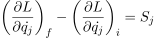
\displaystyle{\bigg( \frac{\partial L}{\partial \dot{q_j}}\bigg)_f}-\bigg( \frac{\partial L}{\partial \dot{q_j}}\bigg)_i=S_j,

as desired.

201902200839 Exercise 5 Chapter 2

A particle is subjected to the potential V(x)=-Fx, where F is a constant. The particle travels from x=0 to x=a in a time interval t_0. Assume the motion of the particle can be expressed in the form x(t)=A+Bt+Ct^2. Find the values of A, B, and C such that the action is a minimum.


Solution.

The solution is not mine. It was found on the Internet some years ago, to whose author(s) I lost references.

1D-case:

\mathcal{L}=T-V=\displaystyle{\frac{1}{2}}m\dot{x}^2+Fx.

Euler-Lagrange (E-L) equation:

\displaystyle{\frac{\mathrm{d}}{\mathrm{d}t}}\bigg( \displaystyle{\frac{\partial \mathcal{L}}{\partial \dot{x}}}\bigg) =\frac{\partial \mathcal{L}}{\partial x}

gives the path over which the action is stationary.

That is,

\begin{aligned} \displaystyle{\frac{\mathrm{d}}{\mathrm{d}t}}( m\dot{x}) & = F \\  \Rightarrow \ddot{x} & =\displaystyle{\frac{F}{m}}\\ \end{aligned}.

On x(t)=A+Bt+Ct^2 taking derivative twice,

\ddot{x}(t)=2C.

Equate them,

C=\displaystyle{\frac{F}{2m}}.

The event (x=0,t=0) gives

A=0.

And the event (x=a,t=t_0) gives

a=x(t_0)=Bt_0+\displaystyle{\frac{F}{2m}}t_0^2.

Express it as

B=\displaystyle{\frac{a-\frac{F}{2m}t_0^2}{t_0}}.

Thus,

x(t)=(0)+\Bigg( \displaystyle{\frac{a-\frac{F}{2m}t_0^2}{t_0}}\Bigg) t+\bigg( \displaystyle{\frac{F}{2m}}\bigg) t^2

is recovered.

201902200829 Derivation 2.3

Prove that the shortest distance between two points in space is a straight line.


Solution.

This solution is not mine. It was found on the Internet some years ago, to whose author(s) I lost references.

Assume the path (of any curve C) connecting two points (a,y(a)) and (b,y(b)) is given by a function C(x)=(x,y(x)), with \displaystyle{\frac{\mathrm{d}}{\mathrm{d}x}}C(x)=(1,y') being the first derivative of the curve.

To minimise the path distance

\displaystyle{\mathcal{L}=\int \| C'\| \,\mathrm{d}x=\int_a^b\sqrt{1+y'^2}\,\mathrm{d}x},

define now

f(x,y,y')=\sqrt{1+y'^2},

having \displaystyle{\frac{\mathrm{d}f}{\mathrm{d}y}}=0 and \displaystyle{\frac{\mathrm{d}f}{\mathrm{d}y'}}=\frac{y'}{\sqrt{1+y'^2}}.

From Euler-Lagrange (E-L) equation it follows that

\displaystyle{\frac{\mathrm{d}}{\mathrm{d}x}}\bigg( \displaystyle{\frac{y'}{\sqrt{1+y'^2}}}\bigg) =0,

i.e., y'=\mathrm{Const.}

In conclusion, the shortest distance between two points in space is a straight line.


Lemma. (Fundamental lemma of the calculus of variations)

If \displaystyle{\int_{x_1}^{x_2}M(x)\eta (x)\,\mathrm{d}x=0} for any \eta (x) continuous through second derivative, then M(x) must identically vanish in the interval x_1,x_2.

Text on pg.38, Goldstein

201902200820 Derivation 1.2

Prove that the magnitude R of the position vector for the center of mass from an arbitrary origin is given by the equation

M^2R^2=M \displaystyle{\sum_i}m_ir_i^2-\displaystyle{\frac{1}{2}\sum_{i\neq j}m_im_jr_{ij}^2}.


Solution.

This solution is not mine. It was found on the Internet some years ago, to whose author(s) I lost references.

\displaystyle{M\mathbf{R}}=\sum m_i \mathbf{r}_i.

Taking squares on both sides,

\displaystyle{M^2\mathbf{R}^2}=\sum_{i,j}m_im_j\mathbf{r}_i\cdot \mathbf{r}_j.

Notice \mathbf{r}_{ij}=\mathbf{r}_i-\mathbf{r}_j, squaring it,

r_{ij}^2=r_i^2-2\mathbf{r}_i\cdot \mathbf{r_j}+r_j^2,

arranging,

\displaystyle{\mathbf{r}_i}\cdot \mathbf{r}_j=\frac{1}{2}(r_i^2+r_j^2-r_{ij}^2).

Plugging this,

\begin{aligned} \displaystyle{M^2R^2} & =\frac{1}{2}\sum_{i,j}m_im_jr_i^2+\frac{1}{2}\sum_{i,j}m_im_jr_j^2-\frac{1}{2}\sum_{i,j}m_im_jr_{ij}^2\\ & = \displaystyle{\frac{1}{2}M\sum_im_ir_i^2}+\frac{1}{2}M\sum_jm_jr_j^2-\frac{1}{2}\sum_{i,j}m_im_jr_{ij}^2\\ & = \displaystyle{M\sum_im_ir_i^2}-\frac{1}{2}\sum_{i\neq j}m_im_jr_{ij}^2 \\ \end{aligned}

201902200814 Derivation 1.1

Show that for a single particle with constant mass the equation of motion implies the following differential equation for the kinetic energy:

\displaystyle{\frac{\mathrm{d}T}{\mathrm{d}t}}=\mathbf{F}\cdot\mathbf{v},

while if the mass varies with time the corresponding equation is

\displaystyle{\frac{\mathrm{d}(mT)}{\mathrm{d}t}}=\mathbf{F}\cdot\mathbf{p}.


Solution.

This solution is not mine. It was found on the Internet some years ago, to whose author(s) I lost references.

Single particle with constant mass:

\begin{aligned} \frac{\mathrm{d}T}{\mathrm{d}t} & =\frac{\mathrm{d}\big(\frac{1}{2}mv^2\big)}{\mathrm{d}t} \\ & =m\mathbf{v}\cdot \mathbf{\dot{v}} \\ & =m\mathbf{a}\cdot \mathbf{v} \\ & =\mathbf{F}\cdot \mathbf{v} \end{aligned}

if mass varies with time:

\begin{aligned} \frac{\mathrm{d}(mT)}{\mathrm{d}t} & =\frac{\mathrm{d}\big( m\times \frac{1}{2}mv^2\big)}{\mathrm{d}t} \\ & =\frac{\mathrm{d}}{\mathrm{d}t}\bigg(\frac{(mv)^2}{2}\bigg) \\ & =\frac{\mathrm{d}}{\mathrm{d}t}\bigg(\frac{p^2}{2}\bigg) \\ & =\mathbf{p}\cdot \mathbf{\dot{p}} \\ & =\mathbf{F}\cdot \mathbf{p} \end{aligned}

Remark.

\begin{aligned} \frac{\mathrm{d}}{\mathrm{d}t}v^2 & =\frac{\mathrm{d}}{\mathrm{d}t}(\mathbf{v}\cdot \mathbf{v}) \\ & =\frac{\mathrm{d}\mathbf{v}}{\mathrm{d}t}\cdot \mathbf{v}+\mathbf{v} \cdot \frac{\mathrm{d}\mathbf{v}}{\mathrm{d}t} \\ & =2\mathbf{v}\cdot \mathbf{a} \end{aligned}