
The blogger claims no originality of his question posted here.
Think of a field in some representation other than a diagram of field lines. For instance, suppose any point in a field is assigned a number to its field strength magnitude, but the direction of field strength of each point is not indicated. Now, could we deduce a rough picture of the (vector) E-field from these (scalar) numbers, provided that we know the distribution of these numbers and the position of charges?

In the figure,  ,
,  and
and  are charges of unknown charge quantities and sign. Each single-digit number at a point represents the magnitude of E-field strength at that point. For example,
  stands for
  ,
,  stands for zero E-field, i.e., a neutral point. By deducing from the figure, determine which of the following statements is/are correct.
(1) Charge quantity of is larger than that of either or .
(2) Charge quantity of equals charge quantity of .
(3) Charge is positive. Charge and charge are both negative.
A. (1) only
B. (2) only
C. (1) and (2) only
D. (1), (2), and (3)
Answer. D

 ,
,  ,
,  , etc. where the potential at


 .
. and
and  are:
are:
 and
and  .
.


 .
.
 ‘s in series is
  :
:
 :
:
 in series,
  :
:
 .
. and
and  .
.

 .
.

 .
. .
. .
.
 ;
;

 .(Alternatively one can use the
  –
– transformation.)
 . Thus
 .
.
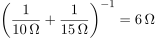 .
.
 .
.
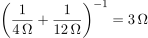 .
.
 .
.