201902250313 Solution to 1987-AL-PHY-I-30

The electrostatic force \mathbf{F}_{XW} acting on the charge -Q at X due to another charge +Q at W is given by Coulomb’s Law:

\mathbf{F}_{XW}=\displaystyle{\frac{(-Q)(+Q)}{4\pi\epsilon_0r^2}}\,\hat{\mathbf{i}}=-\displaystyle{\frac{Q^2}{4\pi\epsilon_0r^2}}\,\hat{\mathbf{i}},

whereas the electrostatic force \mathbf{F}_{XY} due to another charge -Q at Y is given similarly by:

\mathbf{F}_{XY}=\displaystyle{\frac{(-Q)(-Q)}{4\pi\epsilon_0r^2}}\,\hat{\mathbf{j}}=\displaystyle{\frac{Q^2}{4\pi\epsilon_0r^2}}\,\hat{\mathbf{j}}.

When a fourth charge q is placed on Z, which is at a distance of \sqrt{2}r from X where r is the side length of the square, the magnitude of electrostatic force F_{XZ} is given by:

F_{XZ}=\displaystyle{\frac{(-Q)(q)}{4\pi\epsilon_{0}(\sqrt{2}r)^2}}=\displaystyle{\frac{-Qq}{8\pi\epsilon_0r^2}}.

The electrostatic force \mathbf{F}_{XZ} is then given by:

\begin{aligned} \mathbf{F}_{XZ} & = F_{XZ}(\cos 45^\circ )\,\hat{\mathbf{i}} +F_{XZ}(\sin 45^\circ )\,\hat{\mathbf{j}} \\ & = \bigg( \frac{-Qq}{8\pi\epsilon_0r^2} \bigg) \frac{\sqrt{2}}{2} \,\hat{\mathbf{i}} + \bigg( \frac{-Qq}{8\pi\epsilon_0r^2} \bigg) \frac{\sqrt{2}}{2} \,\hat{\mathbf{j}} \\ & = \frac{-\sqrt{2}Qq}{16\pi\epsilon_0r^2} \,\hat{\mathbf{i}} + \frac{-\sqrt{2}Qq}{16\pi\epsilon_0r^2} \,\hat{\mathbf{j}} \end{aligned}


When the net electrostatic force acting on position X is in the left direction only, by summing over the above-calculated three forces, i.e.,

\begin{aligned} \sum \mathbf{F} & =\mathbf{F}_{XW}+\mathbf{F}_{XY}+\mathbf{F}_{XZ} \\ & = \bigg( -\displaystyle{\frac{Q^2}{4\pi\epsilon_0r^2}}+\frac{-\sqrt{2}Qq}{16\pi\epsilon_0r^2}\bigg) \,\hat{\mathbf{i}} + \bigg(\displaystyle{\frac{Q^2}{4\pi\epsilon_0r^2}} + \frac{-\sqrt{2}Qq}{16\pi\epsilon_0r^2}\bigg) \,\hat{\mathbf{j}} \end{aligned}

the vertical component of the electrostatic force must be zero, i.e.,

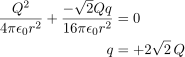
\begin{aligned} \displaystyle{\frac{Q^2}{4\pi\epsilon_0r^2}} + \frac{-\sqrt{2}Qq}{16\pi\epsilon_0r^2} & =0 \\ q & = +2\sqrt{2}\,Q \end{aligned}

And the answer is E.

201902220351 Short Review III (Resistance)

Definition.

Resistance R is a measure of the opposition of an object to the flow of electric charges. Its physical meaning is the potential difference (p.d.) V to be applied across a conductor in order for a current I to flow through it. Mathematically,

\displaystyle{R=\frac{V}{I}}

The unit of resistance is ohm, \displaystyle{\Omega}.

By comparing units,

[\mathrm{resistance}]=\displaystyle{\frac{[\mathrm{potential\,difference}]}{[\mathrm{current}]}},

i.e. 1\,\Omega =1\,\mathrm{V\,A^{-1}}.


Measuring Resistance

By voltmeter-ammeter method (also by a multimeter). This method must contain experimental error, but we can reduce the errors by using different circuit connections.

voltmeter_ammeter_method


For your information: experimental techniques

In the left diagram, the voltmeter gives a correct reading of p.d. V across the resistor. But the ammeter gives a wrong reading of current I because I includes the additional current passing through the voltmeter. By definition, \displaystyle{R=\frac{V}{I}}, the calculated resistance is smaller than the actual one. But if the resistor has small resistance R, the current passing through the voltmeter is small, and hence the error is reduced.

In the right diagram, the ammeter gives a correct reading of current I passing through the resistor. But the voltmeter gives a wrong reading of p.d. V across the resistor because V includes the additional p.d. across the ammeter. By \displaystyle{R=\frac{V}{I}}, the calculated resistance is larger than the actual one. But if the resistor has large resistance R, the p.d. across the ammeter is small, and hence the error is reduced.


Ohm’s Law

Ohm’s law. The potential difference across the ends of a conductor is directly proportional to the current flowing through it (V\propto I), provided that temperature and other physical conditions are unchanged.

Not all conductors obey Ohm’s law, such exception is called non-ohmic. By convention, Ohm’s law qualifies as “a law with exception”, though some persons might even not regard it as a law.


Concept Test

1.  Which of the following statements is/are correct?

I. V=IR, where R varies by V or I, is equivalent to Ohm’s law.
II. \displaystyle{R=\frac{V}{I}} defines the resistance of any material, be it ohmic or non-ohmic.
III. Ohm’s law is obeyed when the curve plotted on a VI graph is a straight line passing through the origin.

A. I and II only
B. I and III only
C. II and III only
D. I, II and III

2. The figures below show the VI or IV graphs of copper wire, filament lamp, diode, and dilute sulphuric acid respectively.Comparing_IV_characteristic_of_materials_copper_wireComparing_IV_characteristic_of_materials_filament_lamp Comparing_IV_characteristic_of_materials_diode Comparing_IV_characteristic_of_materials_dilute_sulphuric_acid

Which of the following statements is/are true?

I. Both copper wire and filament lamp satisfy Ohm’s law.
II. The diode allows current to flow in only one direction, as long as the potential difference across it does not exceed the breakdown voltage.
III. The current flowing through dilute sulphuric acid is directly proportional to the potential difference applied across it.

3. Which of the following statements is wrong?

A. An electrical conductor has no resistance when there is no current passing through it.
B. The resistance of semiconductors decreases when temperature increases.
C. The resistance of superconductors drops to zero when temperature is extremely low.
D. The output voltage of a battery is lower than its e.m.f. because of its internal resistance.


Answers:

  1. C
  2. B
  3. A

Explanation:

  1. II is correct because of the definition. III is correct because Ohm’s law states that for any ohmic conductor, V\propto I, i.e. V=\mathrm{const.} \times I. This constant is the slope of its VI graph, and recall the equation y=mx is a straight line passing through the origin. I is wrong because if R varies according to V or I, V is not directly proportional to I.
  2. I is wrong because in the VI graph of filament lamp the curve is not straight, indicating V is not directly proportional to I. This is because the resistance of filament increases as its temperature increases. Thus, the condition of Ohm’s law, i.e., constant temperature, is not even satisfied. II is correct because at V>V_{\mathrm{break}} the current I is positive, i.e., it is in one direction. III is wrong because the curve is not a straight line passing through the origin, i.e. there is no current even though there is voltage V (0<V<V_{\mathrm{back}}) passing through it.
  3. Options B, C, D are correct statements. Output voltage of a battery means the p.d. across an external circuit; while the e.m.f. of a battery is the energy imparted by the source per unit charge passing through it, where some portion of this energy is “lost” in its internal resistance. A is wrong because resistance exists in conductors, whether there is current passing through it or not.

Factors Affecting Resistance

Temperature T:

T\uparrow\, \Rightarrow R\uparrow.

Length l, thickness/cross-sectional area A:

l\uparrow\,\Rightarrow R\uparrow or A\downarrow\,\Rightarrow R\uparrow.

Resistivity \rho: Each material has its own constant resistivity \rho, defined at a certain temperature.

Combining all factors, at constant temperature:

\displaystyle{R=\rho\frac{l}{A}}

is the resistance (an extrinsic property, depends on physical dimension of materials).

\displaystyle{\rho=\frac{RA}{l}}

is the resistivity (an intrinsic property of materials).

By dimensional analysis,

\displaystyle{[\mathrm{resistivity}]=\frac{[\mathrm{resistance}][\mathrm{area}]}{[\mathrm{length}]}}=\displaystyle{\frac{\mathrm{\Omega\times m^2}}{\mathrm{m}}}=\mathrm{\Omega \,m}.

Concept Test

  1. Which of the following statements concerning resistance of conductors of the same composite material is correct?
    1. If the cross-sectional area A of a conductor is constant, its resistance R is inversely proportional to it length l.
    2. If the length l of a conductor is fixed, its resistance R is inversely proportional to its cross-sectional area A.
    3. For a constant current I flowing through a conductor, resistance R is directly proportional to the potential difference V across it.
    4. For a constant potential difference V across a conductor, its resistance R is inversely proportional to the current I passing through it.
  2. A uniform copper wire of length l and radius r has resistance R. What is the resistance of another uniform copper wire of length 3l and radius 1.5r?
    1. 0.5R
    2. 0.75R
    3. 1.33R
    4. 2R
  3. Which of the following statements concerning resistivity is correct?
    1. Resistivity of a material depends on its temperature.
    2. Resistivity of a material depends on its physical dimension.
    3. Resistivity of insulators is smaller than that of conductors.
    1. I only
    2. I and II only
    3. I and III only
    4. II and III only

Answers:

  1. B
  2. C
  3. A

Explanation:

  1. A is wrong and B is correct because of \displaystyle{R=\rho\frac{l}{A}}. C and D are wrong because R=V/I being the definition of resistance, it indicates that R is constant, independent of applied voltage and current, when the conductor is in constant temperature and of the same composite material.
  2. R=\displaystyle{\rho \frac{l}{A}}=\rho\frac{l}{\pi r^2}. The new resistance R'=\displaystyle{\rho\frac{3l}{\pi (1.5r)^2}}=\frac{4}{3}\bigg( \rho\frac{l}{\pi r^2}\bigg)=1.33R.
  3. I is correct because the higher the temperature, the higher the resistivity. Resistivity is a constant only when defined at a certain temperature. II is incorrect. Resistivity is independent of physical dimension. Do not confuse it with resistance. III is incorrect because insulators’ resistivity is larger than conductors’, as their names suggest. Remark. Resistivity and temperature of a material are intrinsic properties; resistance and physical dimension of a material are extrinsic properties. Intrinsic property affects intrinsic property; extrinsic property affects extrinsic property; but intrinsic property and extrinsic property do not affect each other.

201902220301 Short Review II (Voltage, Electromotive Force, and Potential Difference)

Voltage, p.d. and e.m.f.


Definition.

Voltage V across two points is the change in electric potential energy U per unit charge passing between the points.

The unit of voltage is volt (V). By comparing units, \displaystyle{[\mathrm{voltage}]=\frac{[\mathrm{potential\,energy}]}{[\mathrm{charge}]}}, i.e., 1\mathrm{\,V}=1\mathrm{\,J\,C^{-1}}


Remark. Equivalently, (i) voltage V across two points is the change in electric potential V between the points. In other words, (ii) voltage V across two points is the potential difference \Delta V (p.d.) between two points.

V\stackrel{(\mathrm{def})}{=}\displaystyle{\Delta \bigg(\frac{U}{q}\bigg) =\frac{U_1}{q_1}-\frac{U_2}{q_2}\stackrel{(\mathrm{i})}{=}V_1-V_2\stackrel{(\mathrm{ii})}{=}\Delta V\,\mathrm{(p.d.)}}


Definition.

Electromotive force (e.m.f.) \varepsilon of a power source is the electrical energy per unit charge supplied by the source, when there is charge passing through it.


Remark. The e.m.f. of a source is measured when it is in open circuit, i.e., the source is not in use such that no current is being drawn.

Voltage V refers to e.m.f. \varepsilon when describing a power source, e.g., a cell.

Voltage V refers to p.d. \Delta V when describing an external circuit component, e.g., a load.

Measuring Voltage

By voltmeter, connected in parallel to a component in a circuit. An ideal voltmeter should have infinite resistance.

Voltage in Series and Parallel Circuits

In a series circuit, the sum of the potential differences across each load is equal to the e.m.f. of the power source.

In a parallel circuit, the potential difference across each load is the same as the e.m.f. of the power source.

Cells in Series and Parallel

In a series arrangement, the e.m.f. add up.

In a parallel arrangement, the currents add up.

201902210854 Short Review I (Electric Current)

Definition.

An electric current is a flow of electric charge (through a conductor). We express electric current I by the total electric charge Q flowing through a cross-sectional area per unit time t.

\displaystyle{I=\frac{Q}{t}}

One unit current is of one ampere (1\,\mathrm{A}).

\displaystyle{[\mathrm{current}]=\frac{[\mathrm{charge}]}{[\mathrm{time}]}}, so 1\,\mathrm{A}=1\,\mathrm{C\,s^{-1}}.


Concept Test

  1. An electric current can result from
    1. the movement of atoms.
    2. the movement of electrons.
    3. the simultaneous movement of positive charges and electrons.
      1. I only
      2. III only
      3. I and II only
      4. II and III only
  2. A direct current (d.c.) of 0.8\,\mathrm{A} flows through a wire. How much charge passes through the wire in 30 minutes? And how many electrons flow through it?
    1. 24\,\mathrm{C}; 3.84\times 10^{-18} electrons
    2. 24\,\mathrm{C}; 1.5\times 10^{20} electrons
    3. 1440\,\mathrm{C}; 2.304\times 10^{-16} electrons
    4. 1440\,\mathrm{C}; 9\times 10^{21} electrons
  3. Suppose, on average, 3800 passengers arrive at Central station from Chai Wan station by MTR every hour. The journey takes up 30 minutes, with average speed 70\,\mathrm{km/h}. The average train frequency is one every 3 minutes. Which of the following statements is/are correct?
    1. The total number of passengers on this journey by MTR at any instant is 1900.
    2. 3800 passengers arriving in Central per hour is analogous to a current passing through a cross-sectional area.
    3. Average train speed 70\,\mathrm{km/h} is analogous to the current in a conducting wire segment.
    4. The average train frequency is analogous to the current flowing through a circuit.
    1. I and II only
    2. I and III only
    3. II and III only
    4. III and IV only


Answers:

  1. D
  2. D
  3. A

Explanation:

  1. (I) is wrong because atoms are neutral and do not carry charge. Movement of atoms is not a flow of charge, viz. current. (II) is correct because electrons are charge-carriers. (III) is correct. An example is electrolytes with positive ions and negative ions as charge-carriers.
  2. Charges passing through the wire Q=It=0.8\times 30\times 60=1440\,\mathrm{C} (Caution: use SI-unit). An electron e has 1.6\times 10^{-19}\,\mathrm{C} of negative charge. So 1\,\mathrm{C} of charge consists in \displaystyle{\frac{1}{1.6\times 10^{-19}}}=6.25\times 10^{18} electrons. Thus 1440\,\mathrm{C} corresponds to 1440\times 6.25\times 10^{18}=9\times 10^{21} electrons. Remark: Options A and C do not make sense, how can an electron be split into pieces?
  3. Draw an analogy like this: (i) trains \sim charge carriers; (ii) passengers \sim charge; and (iii) railway \sim circuit. (2) is correct because current I=\displaystyle{\frac{Q}{t}}\sim \displaystyle{\frac{3800\mathrm{\,passengers}}{1\,\mathrm{hr}}}. (I) is correct because the total number of passengers on board a train at any instant is 3800\times time needed for one journey =3800\times 0.5=1900. (III) is wrong because the average train speed \sim the flow of charge carriers \neq the flow of charge. (IV) is wrong because average train frequency \sim density of charge carriers (i.e., electrical conductivity) \neq the current.

Current Direction

By definition, current is the flow of charges (e.g., carried by electrons).

(Charge carriers can be positive, e.g., holes in semi-conductors, positive ions in electrolytes.)

In nature, current is due to the flow of negative electrons from the negative (-ve) terminal to the positive (+ve) terminal of a power source.

An old convention, which is wrong, lasts to date:

Conventional electric current is a flow of positive charge from the +ve terminal to the -ve terminal of a battery.

Conventional current direction is opposite to the direction of electron flow.

External_circuit_direction_of_potential_current_electrons

Measuring Current

By ammeter (also by a current sensor with data-logger, or by galvanometer, which is used for large current, large voltage, and any resistance, like a multimeter), connected in series to a component in a circuit. An ideal ammeter should have zero resistance.

Current in Series and Parallel Circuits

In a series circuit, the current is the same at all points.

In a parallel circuit, the sum of currents passing through each branch is equal to the current in the main circuit.

201902210410 Short Review I (Electric Charge)

Electrostatics is the study of charges at rest.

Two kinds of charge

1. There are two kinds of charge—the positive charge and the negative charge.
2. Like charges repel; unlike charges attract.
3. Since neutrons have no charge, it is said to be neutral.
4. When an object is neither positively nor negatively charged, it is also said to be (electrically) neutral.

How to charge an object?

By (a) rubbing/friction, by (b) inducing charges, or by (c) contact/sharing, there is always a transfer of free charges.

(Capacitors, made up of conductors, can be charged by Extra-High Tension (EHT) power supply.)

Where do charges come from?

Only when an object gains electrons it becomes negatively charged; only when an object loses electrons it becomes positively charged.

Conservation of charge: Charge cannot be created or destroyed.

Unit of charge

The unit is coulomb, written as \mathrm{C}. The charges of a proton and of an electron are +e=1.6\times 10^{-19}\mathrm{C} and -e=-1.6\times 10^{-19}\mathrm{C} respectively.


For your information:

The Triboelectric Series (shortened)

It is the relative position of two materials in this series that determines which one receives electrons and which one donates. The one nearer to the positive end will be positively charged when being rubbed with the other less near, which will then be negatively charged.

(-) Negative End of Series: Silicon rubber < Teflon < Polyethylene < Saran < Orlon < Synthetic rubber < Brass and silver < Nickel and copper < Hard rubber < Sealing wax < Amber < Wood < Steel < Cotton < Paper < Aluminium < Silk < Lead < Wool < Nylon < Glass < Acetate < Asbestos < Human Hands : (+) Positive End of Series


Concept Test

  1. Which of the following statements is correct?
    1. Given that glass rod is positively charged after it is rubbed with a piece of silk, it is also positively charged after it is rubbed with any other materials.
    2. An object could be negatively charged by transferring away some of its protons.
    3. After rubbing two different materials together, each material is charged with the same quantity of charge but with opposite sign.
    4. In the process of inducing charges, an object’s net charge either increases or decreases.
  2. Which of the following statements is/are correct?
      1. Each carbonate ion, \mathrm{CO_3\,^{2-}}, has more electrons than protons.
      2. Sodium ion \mathrm{Na^{+}} has one positive coulomb of charge.
      3. Chloride ion \mathrm{Cl^{-}} has -1.6\times 10^{-19}\mathrm{C} of charge.
    1. I only.
    2. I and II only.
    3. I and III only.
    4. All of the above.

Answers:

  1. C
  2. C

Explanation:

  1. A is wrong: for instance, the glass rod would become negatively charged when it is rubbed with asbestos. Please refer to The Triboelectric Series. B is wrong because the protons are always bound with the neutrons in the nucleus. Only free electrons could be transferred. C is correct because only as such could the charge be conserved. D is wrong because net charge of an object must be unchanged, unless earthing occurs, which will be discussed later on.
  2. I is correct. The superscript (2-) indicates it has two extra electrons than protons. II is wrong, for the superscript (+) means one extra proton than electron so that the charge should be +e, or +1.6\times 10^{-19}\mathrm{C}. By the same reason, III is correct.

Conductors and Insulators

Conductors allow free charges (e.g., electrons, electrolytes) to flow through them easily; insulators do not.

(Not all conductors are metal, e.g., electrolyte is not a metal but a conductor.)

An isolated and charged conductor always has its charges distributed on its surface; the charge density is higher on curved edges and cusps than on flat and smooth surface.

Friction_Induce_Contact_Earthing_Illustration

The above chart illustrates the three processes of charging and the process of earthing. In doing experiments, and also exercises, we often use a combination of some of these four techniques, so make sure you understand and remember them.


Coulomb’s Law

F=k\times \displaystyle{\frac{Q_1Q_2}{r^2}}

where k=\displaystyle{\frac{1}{4\pi \epsilon_0}} is the proportionality constant/Coulomb constant.

F = \displaystyle{\frac{Q_1Q_2}{4\pi \epsilon_0r^2}}

where \epsilon_0=8.85\times 10^{-12}\mathrm{C^2N^{-1}m^{-2}} is the permittivity of free space.

The magnitude of Coulomb force is given above. The direction of the force on each point charge is pointing away from each other when the two point charges Q_1 and Q_2 are of the same sign, whereas pointing towards each other when of opposite sign.

(Point charge, as well as point mass, is an ideal model of particle. When the size of two charge carriers is exceedingly less than their separating distance, we treat them as point charges. For example, the radius of an electron is approximated to 10^{-15} order of magnitude, much less than the radius of an atom 10^{-10}.)


Concept Test

    1. A positively charged glass rod is brought near (without contact) an isolated aluminium rod which is electrically neutral.
      Glass_rod_induces_aluminium_rod_illustration
      Which of the following statements is correct?

      1. The glass rod induces a net negative charge on the aluminium rod.
      2. The electrons are transferred from the aluminium rod to the glass rod.
      3. The net electrostatic force acting on the aluminium rod is zero.
      4. The net electrostatic force acting on the aluminium rod is non-zero.
    2. Sally wants to charge a metallic conductor by friction. After rubbing it with a tablecloth for 5 minutes, she still finds the conductor uncharged. Which of the following statements could best explain the failure?
      1. Conductors can never be charged by friction.
      2. Sally shall continue the rubbing for a longer time.
      3. The charge obtained by the conductor during rubbing flows away through Sally’s body.
      4. The air surrounding the rubbed surface of the conductor is ionized such that the charges acquired flow away through air.
    3. Two identical spherical conductors of radius r are separated by a distance of 5r between their origins. Each of them contains the same amount of charges Q. But one is positively charged; another is negatively charged. Which of the following about electrostatic force is true?
      1. F=\displaystyle{k\frac{(Q)(-Q)}{(5r)^2}}
      2. F=\displaystyle{k\frac{(Q)(-Q)}{(3r)^2}}
      3. None of the above.

Answers:

  1. D
  2. C
  3. C

Explanation:

  1. Unless there is earthing on the aluminium rod, its net charge is conserved. A is wrong. Unless being in contact, the electrons are never transferred from the aluminium rod to the glass rod in mid-air. B is wrong. This aluminium rod would be induced negative (opposite) charges on its front side near the glass rod and positive (like) charges on the back side away from the glass rod. Because the aluminium’s front side is closer to the glass rod than its back side, and electrostatic force \displaystyle{\varpropto \frac{1}{r^2}}, we know the force of attraction is greater than that of repulsion. So there is a non-zero net force acting on the aluminium rod. C is wrong and D is correct.
  2. When Sally’s hand touches the metallic conductor, the conductor is earthed. So the charge acquired by friction is discharged first to her body and then to the ground. Thus, to charge a metallic conductor by friction, it must be held with an insulator.
  3. The Coulomb’s force law does not apply here because we cannot treat the two spherical conductors as point charges, for two reasons: (i) the charge distribution of both conductors is uneven—the charges are denser at the surfaces close to each other, and (ii) the separating distance 5r is only five times the radius r of the spherical conductors, they are in same order of magnitude.

201902210301 Exercise 6.2.1-6.2.3

Again consider polar coordinates on a flat plane. The transformation equations between polar coordinates r, \theta (the primed coordinate system) and Cartesian coordinates x, y (the unprimed coordinate system) are given by equation 6.15. Consider also the vector \mathbf{v} whose components are v^x=1 and v^y=0.


Lowering an index as given by Equation (6.5):

A_\mu \equiv g_{\mu\nu}A^\nu.

In Cartesian coordinate system the metric tensor is

\mathbf{g}=\begin{bmatrix} g_{xx} & g_{xy} \\ g_{yx} & g_{yy}  \end{bmatrix} = \begin{bmatrix} 1 & 0 \\ 0 & 1  \end{bmatrix}

Thus

v_x\equiv g_{x\nu}v^\nu = g_{xx}v^x+g_{xy}v^y =  (1)(1) + (0)(0)=1

v_y\equiv g_{y\nu}v^\nu = g_{yx}v^x+g_{yy}v^y =  (0)(1) + (1)(0)=0


The definition of covector is given by Equation (6.2):

B'_\nu = \displaystyle{\frac{\partial x^\mu}{\partial x'^\nu}}B_{\mu}

So,

v_r=\displaystyle{\frac{\partial x}{\partial r}}v_x + \displaystyle{\frac{\partial y}{\partial r}}v_y = (\cos\theta )(1) + (\sin\theta )(0) = \cos\theta

v_\theta =\displaystyle{\frac{\partial x}{\partial \theta}}v_x + \displaystyle{\frac{\partial y}{\partial \theta}}v_y = (-r\sin\theta )(1) + (r\cos\theta )(0) = -r\sin\theta


The metric tensor for the polar coordinate basis is given by Equation (5.19):

g_{\mu\nu}\equiv \mathbf{e}_{\mu}\cdot\mathbf{e}_\nu = \begin{bmatrix} \mathbf{e}_{r}\cdot\mathbf{e}_r & \mathbf{e}_{r}\cdot\mathbf{e}_\theta \\ \mathbf{e}_{\theta}\cdot\mathbf{e}_r & \mathbf{e}_{\theta}\cdot\mathbf{e}_\theta \end{bmatrix} = \begin{bmatrix} 1 & 0 \\ 0 & r^2 \\ \end{bmatrix}


Exercise 6.2.3.

One can show that in the polar coordinate system, v^r=\cos\theta and v^\theta =-\sin\theta /r (see Problem P6.1). Show that v'^\mu v'_{\mu}=1. Does this make sense?


Equation (6.5):

A_{\mu} \equiv g_{\mu\nu}A^\nu

Hence

\begin{aligned} v_r & \equiv g_{r\nu}v^\nu \\ \cos\theta & = g_{rr}v^r + g_{r\theta} v^\theta \\ \cos\theta & = (1)(v^r) + (0)(v^\theta ) \\ v^r & = \cos\theta \end{aligned}

\begin{aligned} v_\theta & \equiv g_{\theta\nu}v^\nu \\ -r\sin\theta & = g_{\theta r}v^r + g_{\theta\theta} v^\theta \\ -r\sin\theta & = (0)(\cos\theta ) + (r^2)(v^\theta) \\ v^\theta & = \displaystyle{\frac{-\sin\theta }{r}} \\ \end{aligned}

are checked.


\begin{aligned} v'^\mu v'_{\mu}  & = v^r v_r + v^\theta v_{\theta} \\ & = (\cos\theta )(\cos\theta ) + (\displaystyle{\frac{-\sin\theta}{r}})(-r\sin\theta ) \\ & = \cos^2\theta + \sin^2\theta \\ & = 1 \end{aligned}.


Remark. Invariant norm.

201902210253 Exercise 6.1.1-6.1.3

Consider polar coordinates on a flat plane. The transformation equations between the polar coordinates r, \theta (the primed coordinate system) and cartesian coordinates x, y (the unprimed coordinate system) are

Equation (6.15a):

x=r\cos\theta, y=r\sin\theta

Equation (6.15b):

r=\sqrt{x^2+y^2}, \theta =\tan^{-1}\bigg( \displaystyle{\frac{y}{x}} \bigg)

Consider also the scalar function \varPsi =bxy=br^2\cos\theta\sin\theta.

Calculate the four transformation partials \displaystyle{\frac{\partial x^\mu}{\partial x'^\nu}} for the transformations given above:

\displaystyle{\frac{\partial x}{\partial r}}=\cos\theta, \displaystyle{\frac{\partial x}{\partial \theta}}=-r\sin\theta, \displaystyle{\frac{\partial y}{\partial r}}=\sin\theta, \displaystyle{\frac{\partial y}{\partial \theta}}=r\cos\theta.

It can be shown that the gradient of \varPsi in cartesian coordinate system is

\partial_x\varPsi =by and \partial_y\varPsi =bx

and that of \varPsi in polar coordinate system is

\partial_r\varPsi =2br\cos\theta\sin\theta and \partial_\theta\varPsi =br^2[\cos^2\theta -\sin^2\theta].

To make practice of the covector transformation rule:

Equation (6.3):

\partial_\mu\varPsi \equiv \displaystyle{\frac{\partial \varPsi}{\partial x^\mu}}

Equation (6.4):

\partial'_\nu \equiv \displaystyle{\frac{\partial \varPsi}{\partial x'^\nu}} = \displaystyle{\frac{\partial x^\mu}{\partial x'^\nu}}\displaystyle{\frac{\partial \varPsi}{\partial x^\mu}} = \displaystyle{\frac{\partial x^\mu}{\partial x'^\nu}}\partial_\mu \varPsi

Thus,

\begin{aligned} &\quad\enspace \displaystyle{\frac{\partial x}{\partial r}}\partial_x\varPsi +  \displaystyle{\frac{\partial y}{\partial r}}\partial_y\varPsi \\ & = (\cos\theta )(by) + (\sin\theta )(bx) \\ & = (\cos\theta )(br\sin\theta ) + (\sin\theta )(br\cos\theta) \\ & = 2br\cos\theta\sin\theta \\ & = \partial_r \varPsi \end{aligned}

and

\begin{aligned} &\quad\enspace \displaystyle{\frac{\partial x}{\partial \theta}}\partial_x\varPsi +  \displaystyle{\frac{\partial y}{\partial \theta}}\partial_y\varPsi\\ & = (-r\sin\theta )(by) + (r\cos\theta )(bx) \\ & = (-r\sin\theta )(br\sin\theta ) + (r\cos\theta )(br\cos\theta ) \\ & = br^2[\cos^2\theta -\sin^2\theta ] \\ & = \partial_\theta \varPsi \end{aligned}

201902210247 Exercise 5.5.1

Check the cases where \alpha =t and \beta =x, and where \alpha =\beta =x.


Roughwork.

This exercise is to check the transformation law for the metric tensor of flat spacetime, given by Equation (5.16):

\eta'_{\alpha\beta}=\displaystyle{\frac{\partial x^\mu}{\partial x'^\alpha}}\displaystyle{\frac{\partial x^\nu}{\partial x'^\beta}} \eta_{\mu\nu}=\eta_{\mu\nu}(\varLambda^{-1})^\mu_{\enspace \alpha}(\varLambda^{-1})^\nu_{\enspace \beta}=\eta_{\alpha\beta}

(where the second equality is by Equation (5.13), and the third equality by Equation 4.19)


The textbook has already had a checking for \eta'_{tt}=\eta_{tt} through Equations (5.29) and (5.30). I will do the remaining.


Proof. (\eta'_{tx}=\eta_{tx})

\begin{aligned} \eta'_{tx} & = (\varLambda^{-1})^\mu_{\enspace t}(\varLambda^{-1})^\nu_{\enspace x}\eta_{\mu\nu} \\ & = (\varLambda^{-1})^t_{\enspace t}(\varLambda^{-1})^\nu_{\enspace x}\eta_{t\nu} + (\varLambda^{-1})^x_{\enspace t}(\varLambda^{-1})^\nu_{\enspace x}\eta_{x\nu} + (\varLambda^{-1})^y_{\enspace t}(\varLambda^{-1})^\nu_{\enspace x}\eta_{y\nu} \\ & \qquad\quad + (\varLambda^{-1})^z_{\enspace t}(\varLambda^{-1})^\nu_{\enspace x}\eta_{z\nu}\\ \end{aligned}

But the metric tensor given by Equation (4.6):

\begin{bmatrix} \eta_{tt} & \eta_{tx} & \eta_{ty} & \eta_{tz} \\ \eta_{xt} & \eta_{xx} &\eta_{xy} & \eta_{xz} \\ \eta_{yt} & \eta_{yx} & \eta_{yy} & \eta_{yz} \\ \eta_{zt} & \eta_{zx} & \eta_{zy} & \eta_{zz}  \end{bmatrix}\equiv \begin{bmatrix} -1 & 0 & 0 & 0 \\ 0 & 1 & 0 & 0 \\ 0 & 0 & 1 & 0 \\ 0 & 0 & 0 & 1 \end{bmatrix}

tells that

\eta_{t\nu} is nonzero only when \nu =t;

\eta_{x\nu} is nonzero only when \nu =x;

\eta_{y\nu} is nonzero only when \nu =y;

\eta_{z\nu} is nonzero only when \nu =z.

So, the summation continues as follows:

\begin{aligned} \eta'_{tx} & = (\varLambda^{-1})^t_{\enspace t}(\varLambda^{-1})^t_{\enspace x}\eta_{tt} + (\varLambda^{-1})^x_{\enspace t}(\varLambda^{-1})^x_{\enspace x}\eta_{xx} + (\varLambda^{-1})^y_{\enspace t}(\varLambda^{-1})^y_{\enspace x}\eta_{yy} \\ &\qquad\quad + (\varLambda^{-1})^z_{\enspace t}(\varLambda^{-1})^z_{\enspace x}\eta_{zz}\\ & = (\gamma )(\gamma\beta)(-1) + (\gamma\beta)(\gamma)(1) + (0)(0)(1) + (0)(0)(1) \\ & = -\gamma^2\beta + \gamma^2\beta \\ & = 0 \\ & \equiv \eta_{tx} \end{aligned}